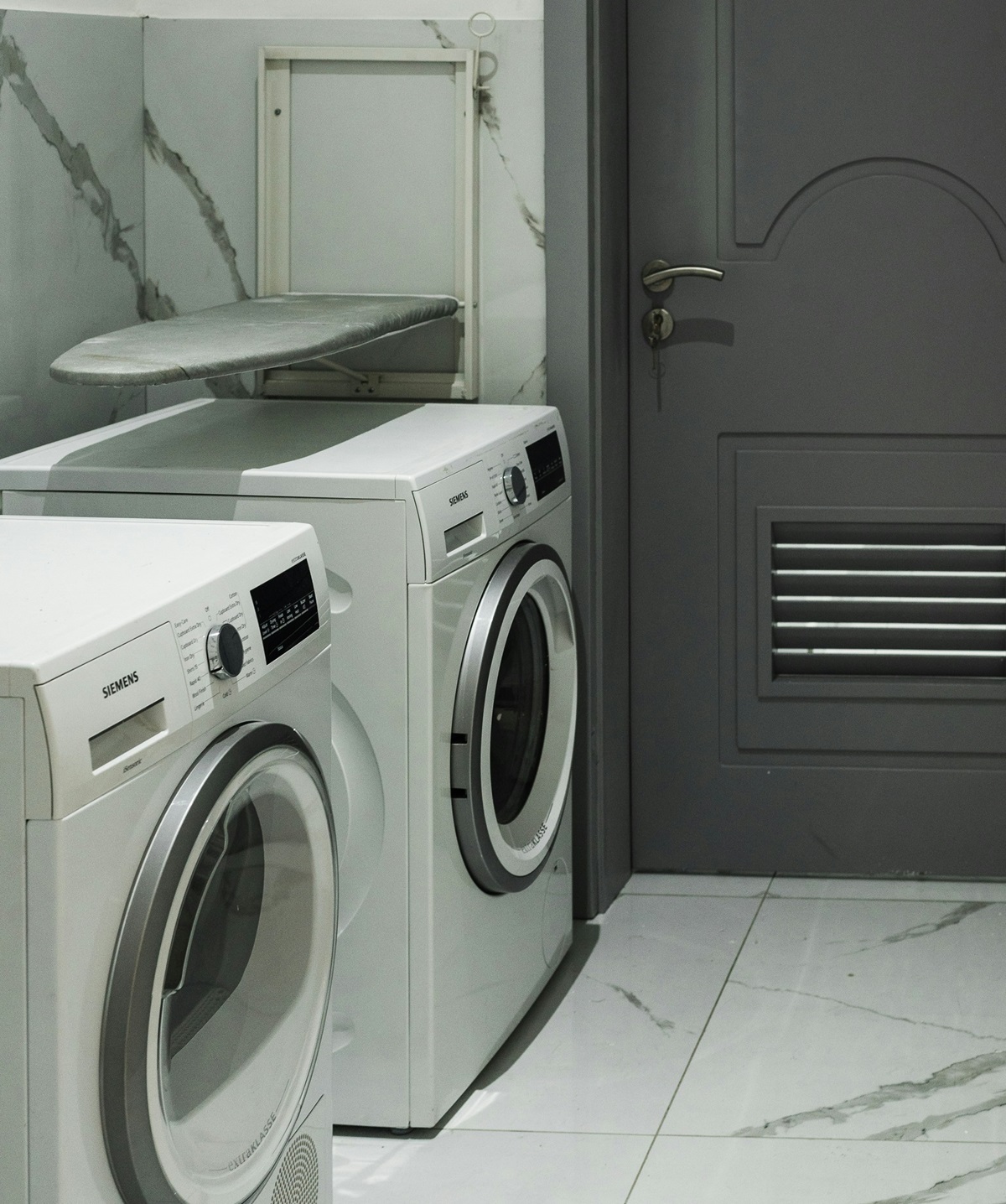
Laundry Room Doors: Styles, Materials and Space-Saving Ideas
Laundry room doors influence available space, ventilation, noise control, privacy, and access to appliances.
The best option depends on the room’s layout, the type of washer and dryer, required clearances, and how frequently the doorway is used.
A conventional hinged door may work well in a separate utility room.
A pocket, bifold, or sliding door may be more practical for a laundry closet or narrow hallway.
Appearance matters, but it should not come before safe ventilation and convenient appliance access.
What to Consider Before Choosing Laundry Room Doors
Measure the complete opening before selecting a door.
Record its width, height, wall thickness, and the amount of free space around it.
Consider the following questions:
- Will a swinging door block the hallway or an appliance?
- Can the washer and dryer pass through the opening?
- Can appliance doors open fully?
- Is ventilation required through the doorway?
- How much wall space is available beside the opening?
- Are pipes, wires, or studs located inside the wall?
- Does the door need to reduce visible clutter or noise?
- Will the opening need to accommodate future appliance replacement?
Check the washer and dryer installation instructions before finalizing the door.
The appliances may require specific clearances or ventilation openings.
Local building, fire, fuel-gas, and mechanical rules may also apply.
Types of Laundry Room Doors
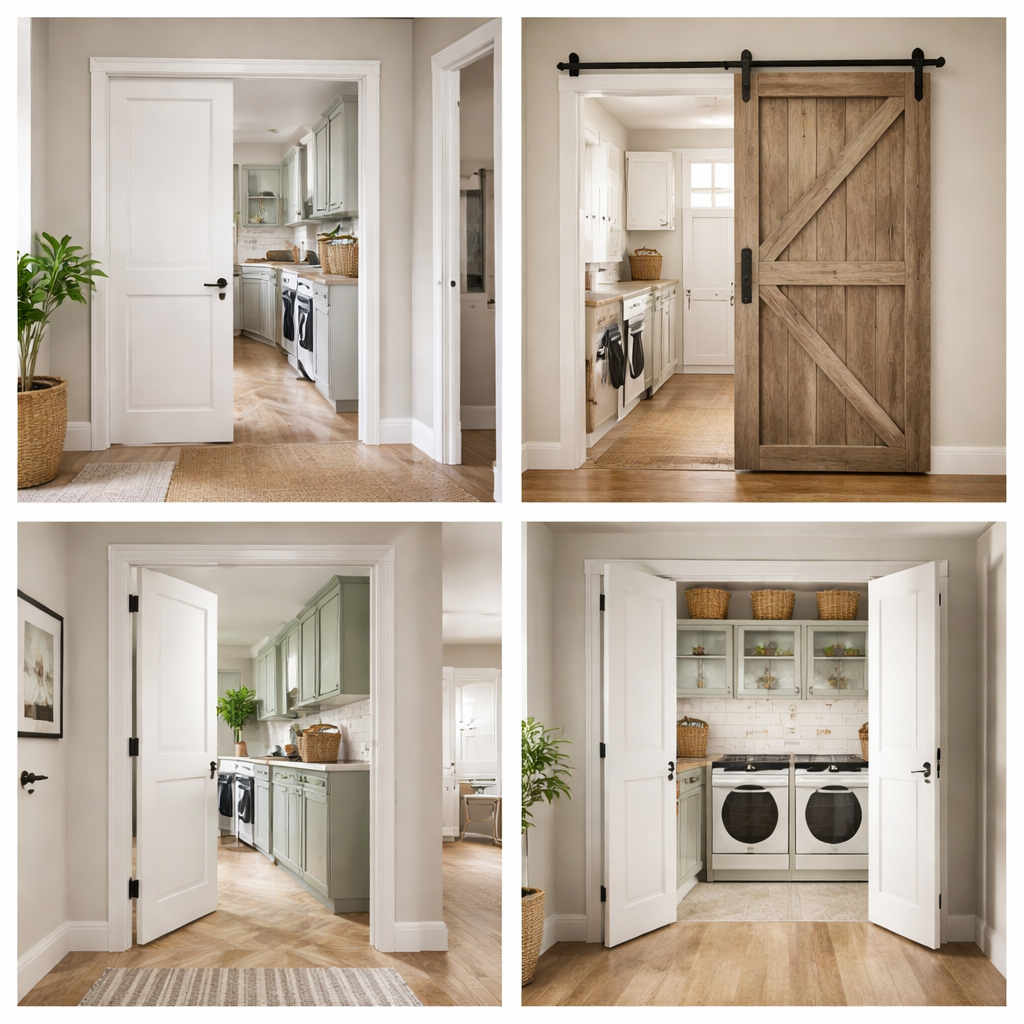
Hinged Doors
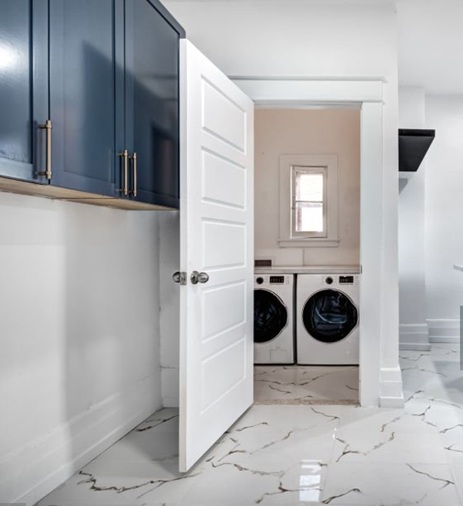
A conventional hinged door is simple, familiar, and usually easy to operate.
It can provide better visual and acoustic separation than many folding or sliding designs.
However, it needs clear floor space for its swing.
Check whether the door will collide with a washer, dryer, cabinet, wall, or hallway traffic.
Sliding Barn Doors
A surface-mounted sliding door moves along the wall.
It does not need swing clearance and can become a decorative feature.
This design requires free wall space beside the opening.
It also leaves gaps around the door, so it provides limited noise and odor control.
Wall switches, outlets, shelving, and artwork can interfere with the sliding path.
The track and mounting surface must support the door safely.
Pocket Doors
A pocket door slides into the wall cavity.
It is useful where both floor space and visible wall space are limited.
Installation is easiest during construction or a larger renovation.
Existing plumbing, electrical cables, ductwork, or structural framing may prevent the wall from accepting a pocket-door frame.
Pocket doors also need accessible hardware and a track that can be serviced.
Do not assume every partition wall can be converted.
Bifold Doors
Bifold doors are commonly used for laundry closets.
They need less projection than full-width hinged doors and can expose most of the opening.
They require accurate alignment.
Low-quality tracks and pivots can become difficult to operate, especially when the panels are heavy.
Bypass Sliding Doors
Bypass panels move in front of one another.
They work well where wall space is unavailable for a barn door.
Only part of the opening is accessible at one time.
Confirm that this provides enough space to install and remove the appliances.
Louvered Doors
Louvered doors allow air to move through the doorway.
They may be appropriate when appliance instructions or local regulations require ventilation.
The open design provides less noise reduction.
Louvers also collect dust and require more detailed cleaning than flat panels.
Accordion Doors
Accordion doors use several narrow folding sections.
They require little swing space and can be useful for lightweight interior separation.
They usually provide limited sound control and may not be as durable as a solid hinged door.
Check the track, panel material, and opening dimensions carefully.
Choosing the Right Door Material
Solid Wood
Solid wood offers a substantial appearance and can help reduce sound transmission.
It can be painted, stained, or refinished.
Wood can move when humidity changes.
Use a suitable finish and follow the manufacturer’s installation instructions.
Solid-Core Composite Doors
A solid-core interior door is usually heavier than a hollow-core model.
Its additional mass may improve noise control when the frame and gaps are also addressed.
Confirm that the hinges, frame, track, and other hardware are rated for the door’s weight.
Hollow-Core Doors
Hollow-core doors are lightweight and often less expensive.
They are easy to operate but normally provide less acoustic separation than heavier doors.
They may still be suitable when noise control is not a priority.
Their lower weight can be useful for some folding systems.
MDF and Engineered Wood
Painted MDF can create a smooth and consistent finish.
It is available in flat, paneled, and decorative designs.
Use a product intended for the location.
Unprotected edges may be vulnerable to moisture, so correct finishing is important.
Glass
Frosted, ribbed, patterned, or opaque glass can share light between the laundry area and an adjoining hallway.
Safety glazing may be required depending on the door and location.
Glass needs regular cleaning and usually provides less privacy when it is clear.
Check the product specifications rather than assuming all decorative glass offers the same performance.
Metal-Framed Doors
Steel- or aluminum-look frames can complement modern and industrial interiors.
They are often combined with clear or textured glazing.
Check the complete door assembly for weight, safety glazing, corrosion resistance, and installation requirements.
Laundry Room Door Ventilation and Appliance Requirements
Do not choose or seal a laundry room door without considering airflow.
A washer, dryer, water heater, boiler, or other appliance may require ventilation or combustion air.
Laundry closet doors may need louvers, transfer grilles, under-door clearance, or another approved source of air.
The required free area depends on the appliances and applicable rules.
A decorative louver does not automatically provide enough airflow.
Always follow:
- The washer and dryer installation manuals
- The instructions for any fuel-burning appliance
- Local building and mechanical requirements
- Local fire and fuel-gas regulations
A vented dryer must exhaust through a suitable duct to the outdoors unless its approved design specifies otherwise.
Do not cover the exhaust opening or use the door as a substitute for correct dryer venting.
The
U.S. Consumer Product Safety Commission dryer safety guidance
recommends cleaning the lint filter, dryer vent, and exhaust duct regularly.
It also advises checking that exhaust air is escaping from the outside vent.
Reducing Washer and Dryer Noise
A heavier door may help reduce laundry noise, but the door is only one part of the solution.
Sound can also travel through gaps, walls, floors, ducts, and the building structure.
Before modifying the door, check that:
- The appliances are level
- The washer load is balanced
- Transit bolts have been removed as instructed
- The machines do not touch cabinets or walls
- Loose hoses and ducts are secured correctly
- The flooring provides stable support
A solid-core hinged door with appropriate perimeter seals can reduce airborne sound.
However, seals must not block ventilation required by the appliances or local regulations.
Sliding and bifold doors normally have more gaps.
They may be better for space management but less effective at separating noise.
Laundry Room Door Ideas for Small Spaces
In a compact laundry area, door movement can interfere with appliances and circulation.
Measure all operating positions rather than only the closed door.
Possible solutions include:
- A pocket door that disappears into a suitable wall
- A bifold door with properly rated hardware
- A bypass system where partial access is acceptable
- A surface-mounted sliding door with enough adjacent wall space
- An outward-opening hinged door where permitted and practical
Make sure the opening remains wide enough for appliance delivery.
A narrow door or fixed center post can make future washer or dryer replacement difficult.
If the laundry area contains only a washer and compact dryer, confirm that the machines are approved for the proposed installation.
Stacked appliances may also have manufacturer-specific clearance and securing requirements.
Are Glass Laundry Room Doors Practical?
Glass doors can bring borrowed light into a laundry room without a window.
They can also prevent a small hallway from feeling closed off.
Clear glass exposes appliances, baskets, and cleaning supplies.
Frosted or textured glass offers more privacy while allowing some light to pass.
Consider how the glass looks at night.
A brightly illuminated laundry room may reveal more through textured glass than expected.
View a sample with light behind it before making a final decision.
Use suitable safety glazing and correctly rated hardware.
Installation requirements vary with the door type and location.
Door Hardware and Operation
Hardware affects appearance, safety, and long-term reliability.
Choose components designed for the door’s type, dimensions, and weight.
Important details include:
- Hinges rated for the door weight
- Tracks with suitable load capacity
- Stops that prevent sliding doors from leaving the track
- Recessed pulls for pocket doors
- Handles that do not interfere with nearby walls or appliances
- Soft-close mechanisms where appropriate
- Accessible handles for household members
Do not select an oversized handle without checking the surrounding clearances.
A projecting pull can strike a wall or prevent a sliding panel from opening fully.
Use floor guides on sliding systems when specified.
They help control panel movement and reduce swinging.
Colors and Finishes for Laundry Room Doors
The door can match surrounding walls for a quiet appearance or create contrast as a decorative feature.
Choose a finish that relates to nearby trim, flooring, cabinets, and hardware.
Versatile options include:
- Warm white for a simple transition
- Soft gray for subtle contrast
- Muted green for gentle color
- Deep blue for a stronger feature
- Charcoal or black for a modern outline
- Natural wood for warmth and visible texture
Use a paint system suitable for the door material.
Prepare and prime the surface according to the paint manufacturer’s directions.
Allow enough curing time before installing or closing the freshly painted door.
If you plan to refinish an existing door, our
painting project guide
offers practical preparation and application tips.
Storage and Functional Additions
The inside surface of a hinged door may provide limited storage.
Lightweight organizers can hold small items when the door and hardware are designed to carry them.
Possible additions include:
- A shallow hanging organizer
- Hooks for empty laundry bags
- A small magnetic or dry-erase planning board
- A compact fold-down drying rack
- A manufacturer-approved door-mounted ironing solution
Do not overload the door.
Added weight can strain hinges, tracks, pivots, and the frame.
Stored items must not block louvers, ventilation grilles, handles, or appliance access.
Cleaning products should be stored securely and kept away from children and pets.
Avoid placing liquids where leakage could reach electrical equipment.
Installation Considerations
A new door should operate without rubbing, binding, or closing unexpectedly.
The frame, wall, and hardware must support the complete assembly.
Before installation:
- Measure the finished opening in several places.
- Confirm the direction of operation.
- Check appliance and ventilation requirements.
- Locate wiring, plumbing, ducts, and structural framing.
- Verify the door and hardware weights.
- Confirm that the opening allows appliance removal.
- Review local permit and safety requirements.
Pocket doors, heavy glass doors, structural changes, and doors near fuel-burning appliances may require professional assessment.
Do not cut into a wall until concealed services and structural conditions are understood.
When replacing the appliances as part of the project, consult our guide to
choosing a washing machine
before finalizing the available clearances.
Common Laundry Room Door Mistakes
Ignoring Ventilation
A tightly sealed door may reduce airflow required by the appliances.
Check all instructions and applicable regulations first.
Choosing a Door That Blocks the Appliances
Test the positions of the room door, washer door, dryer door, cabinets, and drawers.
They should not prevent one another from opening.
Forgetting Appliance Replacement
The existing machines may already be inside the room.
Make sure future appliances can pass through the completed doorway.
Installing a Barn Door Without Wall Space
A sliding panel needs an unobstructed path.
Switches, outlets, trim, and shelving can prevent full operation.
Expecting a Sliding Door to Block All Noise
Sliding doors normally leave perimeter gaps.
A solid hinged assembly is generally better when acoustic separation is the main goal.
Adding Too Much Door Storage
Heavy organizers can damage hardware or pull the door out of alignment.
Respect the load capacity of the complete system.
Choosing Appearance Before Safety
The material, glazing, hardware, ventilation, and installation method must suit the location.
A decorative design is not appropriate if it creates unsafe operation.
Laundry Room Door Planning Checklist
- Measure the complete finished opening.
- Check the required appliance clearances.
- Confirm that appliances can pass through the doorway.
- Identify the available swing or sliding space.
- Review ventilation and combustion-air requirements.
- Choose a door material suited to the room.
- Select hardware rated for the door’s weight.
- Check for wiring, pipes, ducts, and structural framing.
- Plan access to the dryer vent and appliance connections.
- Make sure stored items will not block airflow.
- Compare the door finish with nearby rooms and trim.
- Use a qualified installer when the project requires structural or technical work.
Frequently Asked Questions
What is the best door for a small laundry room?
The best option depends on the available wall and floor space.
Pocket, bifold, bypass, and surface-mounted sliding doors can all reduce swing clearance.
Each design has different access and installation requirements.
Do laundry room doors need vents?
Some laundry rooms and closets require ventilation.
The answer depends on the appliances, their installation instructions, and local regulations.
Do not cover existing louvers or grilles without confirming that they are unnecessary.
Can I use a barn door for a laundry room?
Yes, if there is enough clear wall space and the mounting structure can support it.
Remember that gaps around a barn door limit privacy, airflow control, and noise reduction.
Are bifold doors suitable for laundry closets?
Bifold doors can work well in compact areas.
Check that the panels provide enough opening width and do not interfere with appliance controls or doors.
Which laundry room door reduces noise best?
A correctly installed solid-core hinged door generally provides better acoustic separation than a lightweight folding or sliding door.
Required ventilation must still be maintained.
Can a laundry room door open outward?
It may be possible, but the door must not create a hazard or obstruct a required path.
Check the surrounding layout and applicable local requirements.
Is frosted glass suitable for a laundry room?
Frosted glass can share light while providing more privacy than clear glass.
Its actual transparency varies, especially when the room is illuminated from behind.
Should a laundry room door match the other doors?
It can match nearby doors for continuity or use a contrasting finish as a feature.
The choice should relate to the surrounding trim, walls, furniture, and flooring.
Final Thoughts
Laundry room doors should support the way the room operates.
Door swing, appliance access, ventilation, noise, hardware, and maintenance are more important than following a temporary trend.
Measure carefully and check the appliance instructions before choosing a design.
A well-planned door can save space, improve access, and connect the laundry area naturally with the rest of the home.