Plastic Skirting Boards: Benefits, Installation and Costs
What Are Plastic Skirting Boards?
Skirting boards, also called baseboards, cover the joint where the wall meets the floor. They help protect the lower wall from shoes, furniture, vacuum cleaners, and everyday contact.
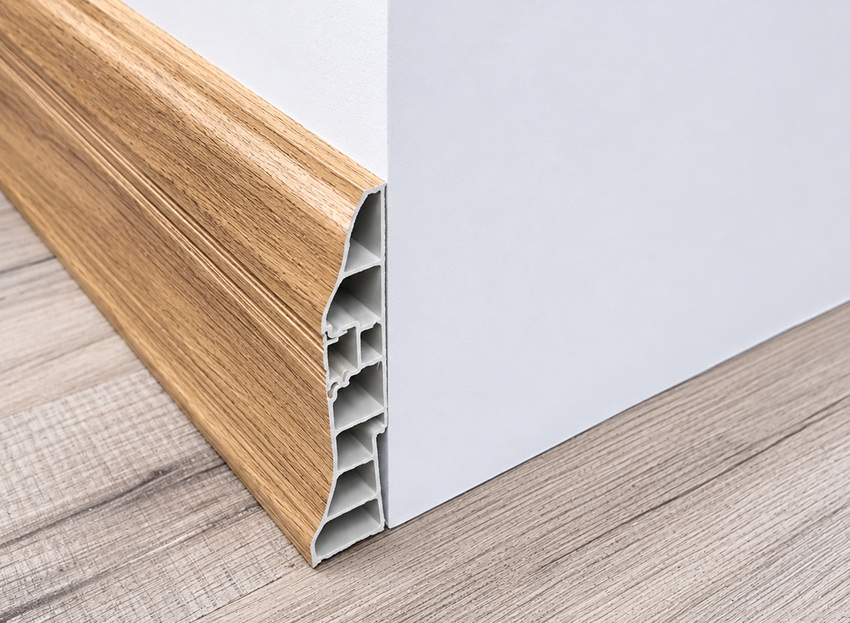
Plastic skirting boards are commonly manufactured from PVC. Depending on the product, they may have a solid or hollow profile, a decorative finish, removable covers, or an integrated cable-management system.
Popular finishes include white, gray, black, and wood-look designs that coordinate with laminate, vinyl, or other flooring materials.
Understanding Height and Projection
Before choosing a profile, compare two important dimensions:
- Height: how far the skirting board extends up the wall.
- Projection: how far the profile extends outward from the wall.
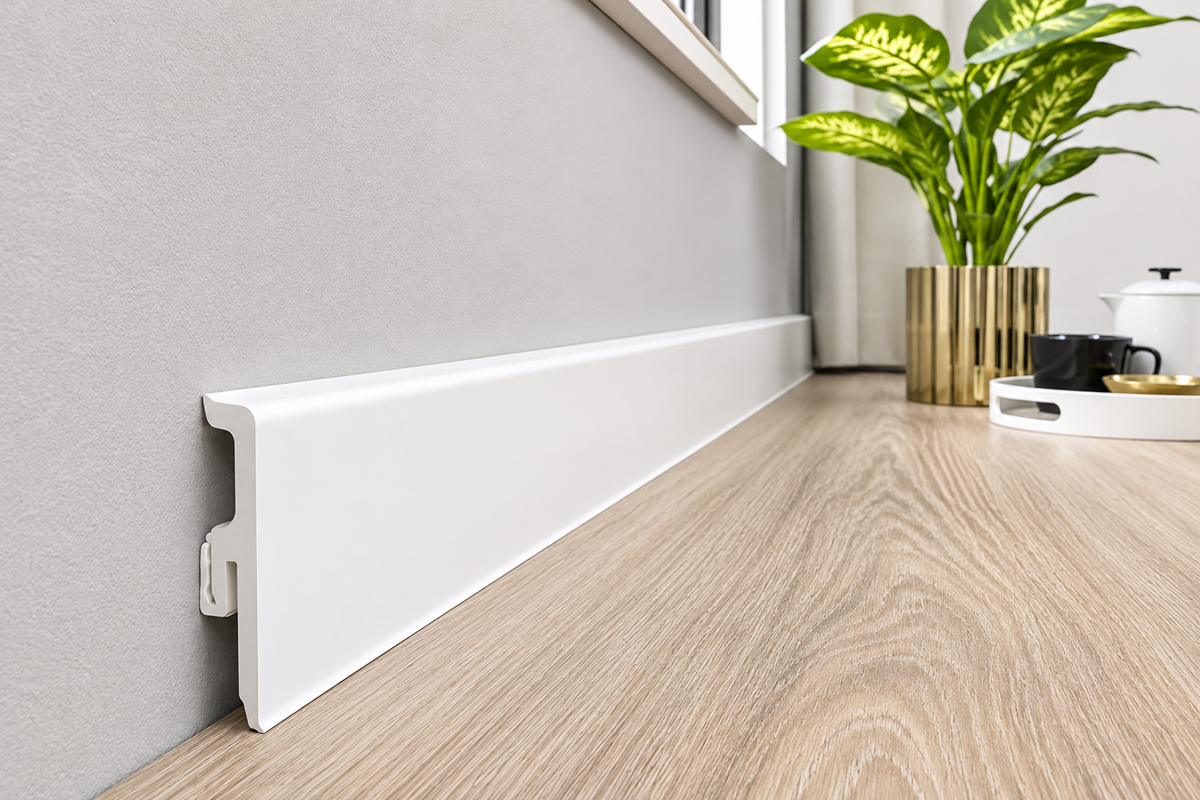
A taller profile can cover old paint lines or marks left by previous skirting. The projection helps determine whether the board can conceal the required expansion gap at the floor edge.
Always test a sample against the actual wall and floor, especially where the wall is uneven or the gap varies.
Plastic vs MDF vs Timber Skirting Boards
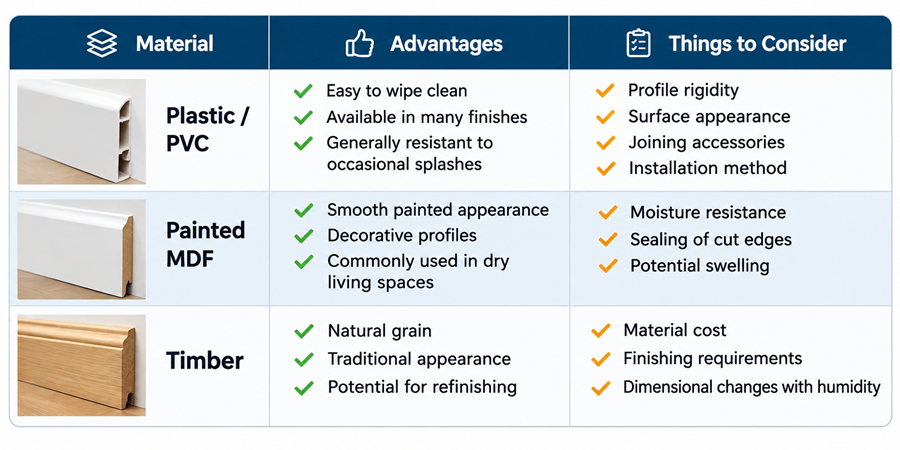
Plastic, MDF, and timber skirting boards can all provide an attractive finish. Their suitability depends on moisture exposure, installation requirements, maintenance preferences, and the desired appearance.
When Is PVC a Good Choice?
PVC skirting can be particularly useful where the lower wall needs frequent cleaning or occasional contact with water.
It is also worth considering when you want matching corner pieces, end caps, or a profile designed for cable management.
When Is Wood or MDF More Suitable?
Timber may be preferable when natural grain is an important part of the interior design.
Painted MDF can be a practical option for dry rooms where you want a traditional or decorative profile that matches existing trim.
The best choice depends on the complete installation rather than the material alone.
Moisture Resistance and Cleaning
A PVC skirting profile generally tolerates occasional splashes better than ordinary, unprotected MDF.
However, the complete installation includes joints, fixings, adhesives, and the wall behind the board. A moisture-resistant profile does not automatically make the wall-to-floor junction waterproof.
Cleaning PVC Skirting Boards
For routine cleaning, use a soft damp cloth and a cleaning product compatible with the finish.
Avoid abrasive pads and aggressive solvents unless the manufacturer specifically approves them.
Installation in Damp Areas
For kitchens, laundry rooms, and other splash-prone spaces, verify that the profile, accessories, and fixing system are suitable for the intended conditions.
If moisture is entering from behind the wall or beneath the flooring, investigate and correct the underlying problem rather than relying on skirting boards to conceal it.
If you are also planning to replace the flooring, see our guide to kitchen flooring options for related material considerations.
How to Measure and Install Plastic Skirting Boards
Installation methods vary between products. Some skirting boards are attached using clips, others use adhesive, and certain profiles are designed for mechanical fixings.
Always follow the manufacturer’s instructions for the specific system.
Step 1: Measure Each Wall
Measure the lengths of the walls and identify door openings, internal and external corners, alcoves, and exposed ends.
Record the dimensions and prepare a simple sketch before purchasing materials.
Step 2: Check the Wall and Flooring
Inspect the wall surface for uneven areas, loose plaster, moisture damage, or other problems that could affect installation.
If the floor is floating, the skirting must not prevent the flooring from expanding and contracting as specified by the flooring manufacturer.
Step 3: Prepare the Profiles
Check how each board connects to internal corners, external corners, joining pieces, and end caps.
Dry-fit components before making the final cuts.
Step 4: Install the Fixing System
Use the clips, adhesive, or mechanical fixings recommended for the selected profile.
When using adhesive, make sure it is suitable for both the PVC material and the wall surface.
Step 5: Install Corners and End Caps
Use matching accessories where available to create a neat finish at corners, doors, and exposed ends.
Step 6: Inspect the Finished Installation
Check that the boards are securely attached, joints are correctly seated, and the flooring remains free to move where necessary.
Where the system includes a removable cover, verify that it can still be opened without damaging the surrounding finish.
Plastic Skirting Boards With Cable Channels
Some PVC skirting systems include hollow compartments or removable covers designed to accommodate compatible cables.
These profiles can be useful in home offices, living rooms, or other areas where cable routes need to remain accessible.
Before choosing a cable-channel profile, check its internal dimensions, access system, corner fittings, and approved cable types.
Check Cable Compatibility
Not every hollow PVC profile is approved for electrical wiring. A hollow construction alone does not establish that the product is an electrical cable-management system.
Only use a cable channel for the cable types and installation methods approved by its manufacturer and applicable electrical regulations.
Power and low-voltage communication cables may have specific separation requirements. Electrical wiring should be planned and installed by a qualified professional where required.
Plan Access Before Installation
Think about where cables need to enter and leave the channel and whether connectors can pass through the available openings.
In a home office, plan the desk position, power outlets, and equipment locations before choosing a cable route.
Our guide to home office design offers additional layout inspiration.
How Much Skirting Board Should You Buy?
Calculating the required quantity before ordering helps reduce waste and avoid unnecessary additional purchases.
Example: A 4 m by 3 m Room
Imagine a rectangular room measuring 4 meters by 3 meters, with one doorway 0.9 meters wide.
The wall perimeter is:
4 + 3 + 4 + 3 = 14 m
Subtracting the doorway gives:
14 − 0.9 = 13.1 m
If the boards are supplied in 2.4-meter lengths:
13.1 ÷ 2.4 ≈ 5.46 lengths
Rounding up gives a minimum of six full lengths, providing 14.4 meters of material.
However, this is only a preliminary estimate. Cutting waste, corner arrangements, unusable offcuts, and the positioning of visible joints may increase the quantity required.
Include Accessories in the Budget
When comparing skirting board prices, include:
- Skirting board lengths
- Internal and external corners
- Joining pieces
- End caps
- Mounting clips or adhesive
- Any necessary installation tools
- Delivery and labor, if applicable
Two skirting profiles with the same price per meter can have significantly different total costs once accessories and installation are included.
Which Plastic Skirting Profile Works Best in Each Room?
The appropriate profile depends on how the room is used, the existing flooring, and the desired appearance.
Kitchen
Choose a profile that is easy to clean and suitable for occasional splashes. Pay attention to joints and the condition of the wall behind the skirting.
Laundry or Utility Room
Consider a moisture-resistant profile with accessories that tolerate regular cleaning and everyday knocks.
Garage or Workshop
Look for a sufficiently robust fixing system and consider the availability of replacement corner pieces or end caps.
Living Room
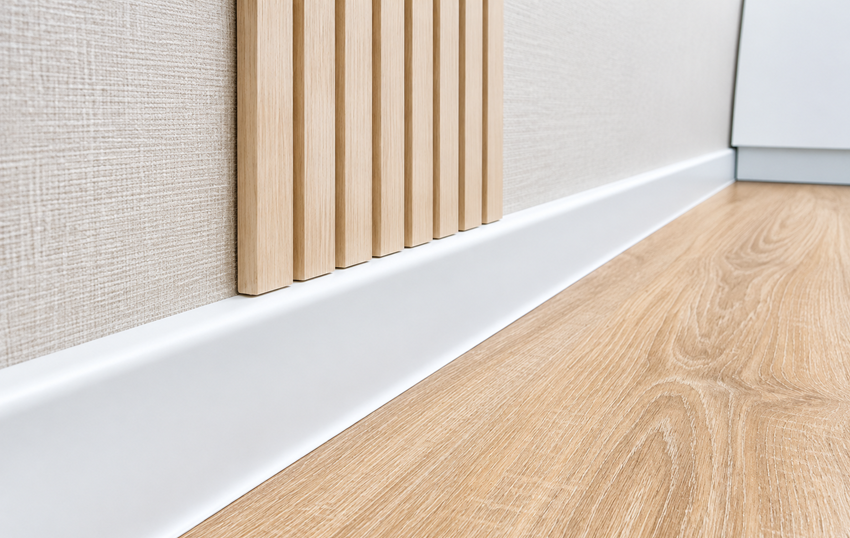
Appearance may be the main priority. Match the profile to the wall color, flooring, and door trim.
Home Office
A profile with an approved cable-management channel may help organize certain cables while maintaining access for future changes.
Always verify the product’s intended use and electrical suitability before installation.
When Another Material May Be a Better Fit
PVC skirting boards are versatile, but they are not the ideal solution for every interior.
Traditional Decorative Interiors
Painted MDF or timber may be preferable when matching an existing decorative profile or period-style trim.
Rooms With Natural Wood Finishes
Solid timber skirting can provide a coordinated natural appearance alongside wooden doors, frames, or other architectural details.
Walls With Significant Irregularities
A rigid skirting profile may leave visible gaps against an uneven wall.
Test an actual sample before buying. Depending on the situation, wall preparation or another suitable profile may produce a better result.
Areas With Special Fire or Electrical Requirements
Some installations require specific fire-performance ratings, cable-management approvals, or other product characteristics.
Choose products that meet the requirements of the intended application rather than assuming that standard decorative PVC skirting is suitable.
Common Plastic Skirting Board Mistakes to Avoid
Choosing the Height Without Checking the Floor Gap
A tall skirting board may conceal wall marks but still have insufficient projection to cover the flooring expansion gap.
Ignoring Corner Accessories
Check that compatible corner pieces, joining elements, and end caps are available before ordering.
Installing Over Moisture Damage
Skirting boards should not be used to conceal unresolved dampness, leaks, or deteriorating wall surfaces.
Fixing a Floating Floor in Place
Follow the flooring manufacturer’s guidance so that the skirting does not restrict the floor’s required movement.
Using an Unapproved Cable Channel
A hollow profile should not be treated as an approved electrical conduit unless its specifications support that use.
Ordering Without a Cut List
Calculating only the total perimeter may underestimate the amount of material needed when offcuts cannot be reused.
Frequently Asked Questions About Plastic Skirting Boards
Are plastic skirting boards waterproof?
Many PVC profiles are highly resistant to moisture, but the complete installation is not necessarily waterproof. Joints, adhesives, fixings, and the wall behind the board may still be affected by water.
Can PVC skirting boards be painted?
Some PVC profiles can be painted using suitable preparation products and coatings. Check the manufacturer’s recommendations for primers, paints, and surface preparation.
Can plastic skirting boards be used with laminate flooring?
Yes, provided the chosen profile covers the required expansion gap and its installation does not restrict the movement of the floating floor.
Are PVC skirting boards better than MDF?
Neither material is universally better. PVC may be more practical where moisture resistance and easy cleaning are priorities, while MDF can be suitable for dry rooms requiring a painted decorative finish.
Can plastic skirting boards hide electrical cables?
Only if the selected system is designed and approved for the intended cables and installation method. Ordinary hollow decorative skirting should not automatically be treated as an electrical cable channel.
How do you calculate the amount of skirting needed?
Measure the wall runs, subtract openings where skirting will not be installed, and divide by the supplied board length. Prepare a cut list and allow for unusable offcuts, corners, and joints.
Can PVC skirting be installed over existing skirting boards?
Some overlay systems are designed for this purpose. Standard PVC skirting profiles are not necessarily suitable for installation over existing trim. Check the product’s intended installation method.
Before You Order Plastic Skirting Boards
Plastic skirting boards can provide a practical finishing detail, particularly in rooms where easy cleaning, occasional moisture exposure, or cable management are important considerations.
Before purchasing, bring home a sample and compare its height, projection, finish, and stiffness against the actual wall and flooring.
Check the widest floor gap, test the profile at corners and door frames, and confirm that the necessary accessories are available.
Finally, prepare a cut list and calculate the full cost of boards, corners, joiners, fixings, and installation.
The right skirting profile should not only look attractive but also cover the required gap, suit the room’s conditions, and remain practical to maintain.