Kitchen Flooring Options: Materials, Pros and Cons
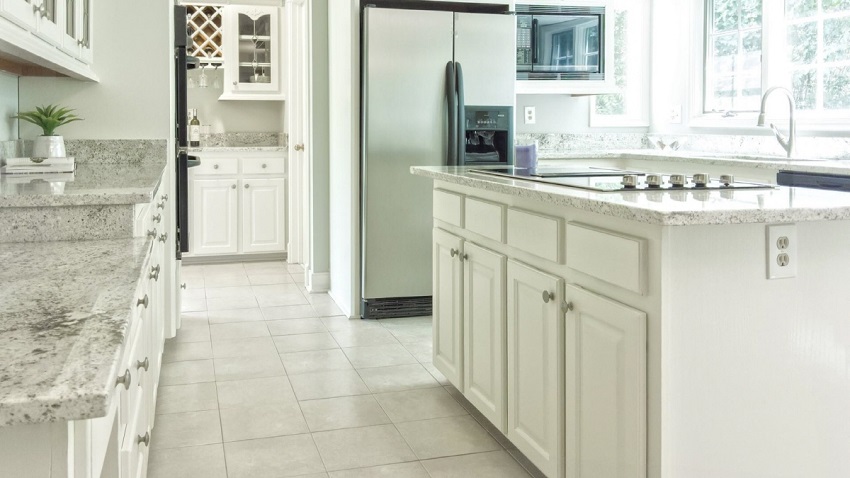
Kitchen flooring options should be compared by water resistance, durability, comfort, maintenance, installation requirements, and cost.
The kitchen floor must cope with spills, dropped objects, frequent cleaning, chair movement, and heavy appliances.
Porcelain tile and vinyl are practical choices for many busy kitchens.
Wood offers warmth and can often be repaired, while stone and concrete provide a substantial appearance.
The best material depends on the subfloor, household, climate, and expected maintenance.
What Does a Kitchen Floor Need?
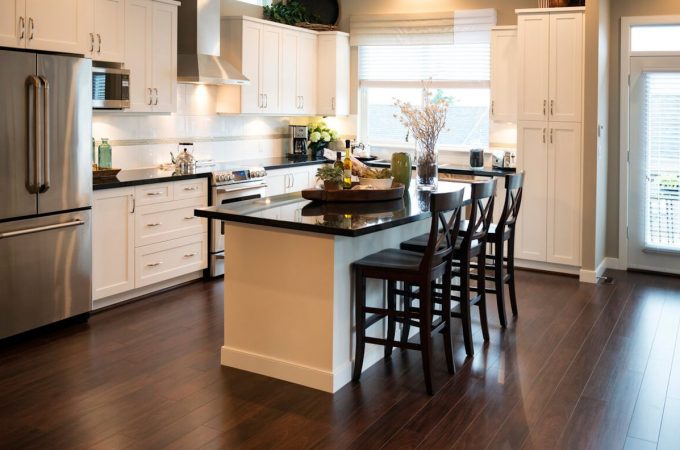
Kitchen flooring should be selected for the way the room is actually used.
A floor that performs well in a lightly used apartment may be less suitable for a large household with children and pets.
Consider the following requirements:
- Moisture resistance: spills and appliance leaks can reach the floor.
- Durability: the surface must tolerate foot traffic and moving chairs.
- Stain resistance: cooking oils, sauces, and drinks may leave marks.
- Slip resistance: the surface should remain practical when small spills occur.
- Comfort: hard floors may become tiring during long cooking sessions.
- Repairability: individual boards or tiles may need replacement.
- Cleaning requirements: some materials need specialized products.
- Subfloor compatibility: the base must support the proposed material.
- Appliance weight: refrigerators, ranges, and islands create concentrated loads.
Also consider adjoining rooms.
An open-plan kitchen often looks more cohesive when the flooring continues into the dining or living area.
However, one material may not perform equally well in every location.
Flooring should be planned alongside cabinets, islands, lighting, and circulation.
Our guide to
functional kitchen design
explains how these elements work together.
Kitchen Flooring Options Compared
| Material | Moisture performance | Comfort | Maintenance | Main consideration |
|---|---|---|---|---|
| Porcelain tile | High when correctly installed | Hard underfoot | Generally straightforward | Grout and substrate need attention |
| Sheet vinyl | Good with correctly detailed seams and edges | Moderately resilient | Easy for many products | Damage can be difficult to repair invisibly |
| Luxury vinyl | Product-specific | Less hard than tile | Usually simple | Water may still reach the subfloor at edges |
| Engineered wood | Limited | Warmer than stone or tile | Requires prompt spill removal | Standing water can cause damage |
| Laminate | Varies by product | Moderate with underlay | Usually easy | Core and joints may swell if water penetrates |
| Natural stone | Varies by stone and treatment | Hard underfoot | May require sealing | Porosity and cleaner compatibility vary |
| Concrete | Depends on finish and sealing | Hard underfoot | Finish-specific | Cracks and moisture movement require planning |
| Cork | Limited to product and installation | Comfortable and quieter | Requires appropriate care | Can dent and needs protection from water |
| Linoleum | Moderate with correct installation | Resilient | Product-specific | Seams and edges need protection |
These are general characteristics.
Performance can vary significantly between products with the same material name.
Review the manufacturer’s specifications, warranty, installation instructions, and cleaning requirements.
Porcelain and Ceramic Tile
Tile is one of the most established kitchen flooring options.
It is available in many sizes, colors, textures, and patterns.
Porcelain Tile
Porcelain is dense and available in products intended for demanding floor applications.
Correctly selected and installed porcelain can provide strong resistance to water, stains, and wear.
Potential advantages include:
- Wide choice of colors and formats
- Good compatibility with frequent cleaning
- Strong resistance to everyday wear
- Suitability for many underfloor-heating systems
- Ability to replace an individual tile when a matching spare is available
Possible disadvantages include:
- A hard and cool surface
- Risk of chipping from heavy dropped objects
- Demanding substrate preparation
- Visible or stained grout when maintenance is neglected
- Difficult removal during a future renovation
Ceramic Tile
Ceramic tile may be less dense than porcelain.
Some ceramic products are designed for walls rather than floors.
Check the intended use and performance rating before purchase.
A tile surface is only part of the floor system.
Grout, movement joints, waterproofing where required, adhesive, and the subfloor all affect long-term performance.
Vinyl Kitchen Flooring
Vinyl flooring is available as sheet material, tiles, and planks.
It can reproduce the appearance of wood, stone, or concrete while providing a more resilient surface.
Sheet Vinyl
Sheet vinyl can cover a small kitchen with relatively few seams.
This may help limit the paths through which spills reach the subfloor.
Accurate fitting is important around cabinets, pipes, doorways, and appliances.
A large cut or tear can be difficult to repair without leaving a visible patch.
Luxury Vinyl Plank and Tile
Luxury vinyl planks and tiles offer many design options.
Individual pieces may be easier to replace than sheet flooring.
Terms such as “waterproof” should be interpreted carefully.
The flooring material may resist water, but moisture can still travel through joints, edges, wall gaps, or penetrations and reach the subfloor.
Follow the installation instructions for expansion gaps, underlay, moisture testing, and fixed cabinets.
Some floating floors should not be trapped beneath heavy permanent cabinetry or islands.
Solid and Engineered Wood Flooring
Wood brings natural variation and visual warmth to a kitchen.
It can also create continuity with adjacent living and dining areas.
Solid Wood
Solid wood can often be sanded and refinished.
The number of possible refinishing cycles depends on board thickness, construction, condition, and installation.
Wood responds to changes in moisture.
Spills and appliance leaks must be handled promptly.
The room’s humidity and subfloor conditions should remain within the flooring manufacturer’s specified range.
Engineered Wood
Engineered wood uses a real wood surface over a layered core.
It may be more dimensionally stable than solid wood in some installations.
This does not make it immune to water damage.
Before choosing wood, consider:
- The thickness of the wear layer
- Whether the product can be refinished
- The installation method
- Moisture limits
- Compatibility with underfloor heating
- Warranty exclusions for kitchens or leaks
Place protective pads beneath movable furniture.
Avoid mats with backings that can trap moisture or react with the floor finish.
Laminate Kitchen Flooring
Laminate flooring uses a decorative image beneath a protective wear layer.
It can provide a wood or stone appearance at a lower cost than some natural materials.
Potential advantages include:
- Wide range of designs
- Quick installation for compatible systems
- Good scratch resistance in many product lines
- Simple routine cleaning
Possible disadvantages include:
- Water can damage the core or joints
- Damaged boards normally cannot be refinished
- Replacement may require dismantling part of a floating floor
- Sound and feel vary according to the product and underlay
Some laminate products offer enhanced water resistance.
Check how long the manufacturer allows spills to remain and which areas are excluded from the warranty.
Natural Stone Kitchen Flooring
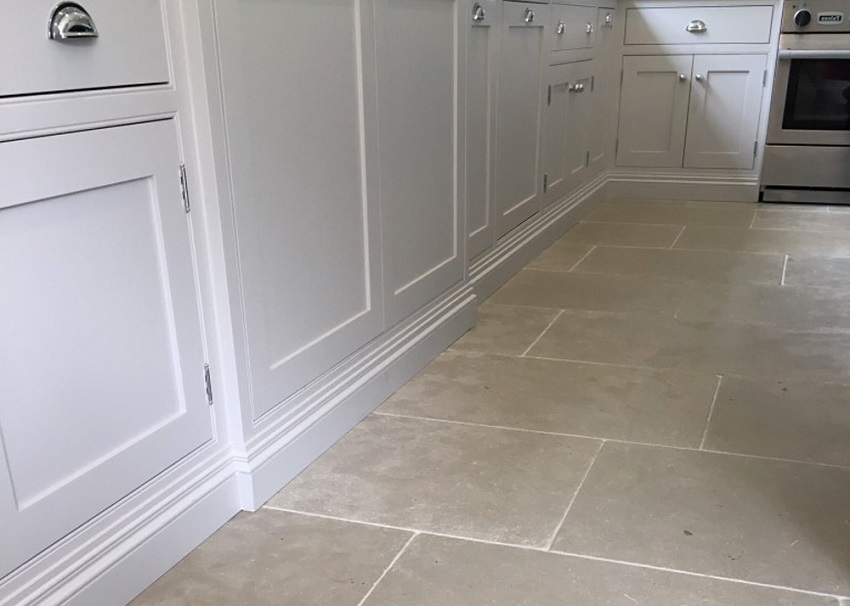
Natural stone provides individual color and pattern variation.
Granite, slate, limestone, and travertine have different characteristics and should not be treated as one uniform material.
Potential advantages include:
- Distinctive natural appearance
- Long service life when correctly specified
- Compatibility with some underfloor-heating systems
- Availability in several formats and finishes
Important considerations include:
- Some stones are porous
- Sealing requirements vary
- Acidic substances can damage certain stones
- The surface may become slippery when wet
- The structure and subfloor must support the installation
- Natural variation may be greater than the showroom sample
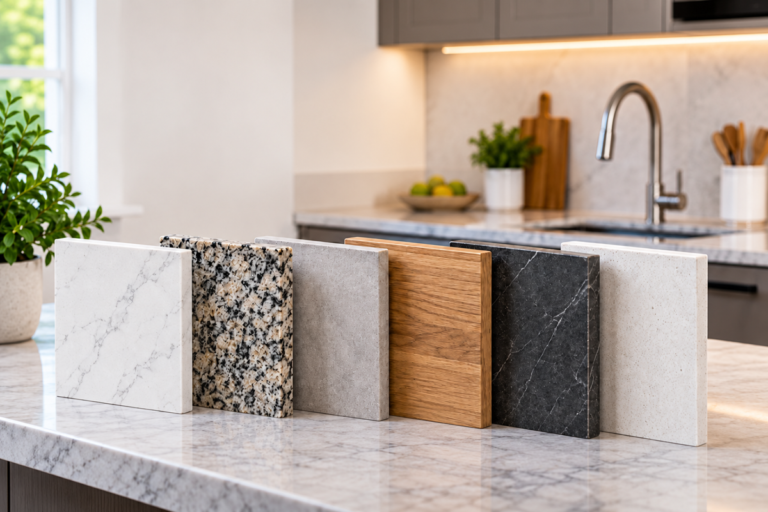
Request several samples or inspect the actual batch.
A small display board cannot represent every variation found in natural stone.
Marble Kitchen Flooring
Marble is a natural stone known for its veining and polished appearance.
It can create an elegant floor, but it is not maintenance-free.
Acidic foods and cleaners can etch calcite-based stones such as marble.
Oil and strongly colored liquids may stain some installations.
The selected finish and sealer influence maintenance but do not make the stone indestructible.
A highly polished marble floor may be slippery, especially when wet.
Consider a finish and product specifically suited to the location.
Before installation, discuss:
- Slip resistance
- Sealing requirements
- Grout selection
- Stone variation
- Subfloor movement
- Cleaning-product compatibility
Concrete Kitchen Flooring
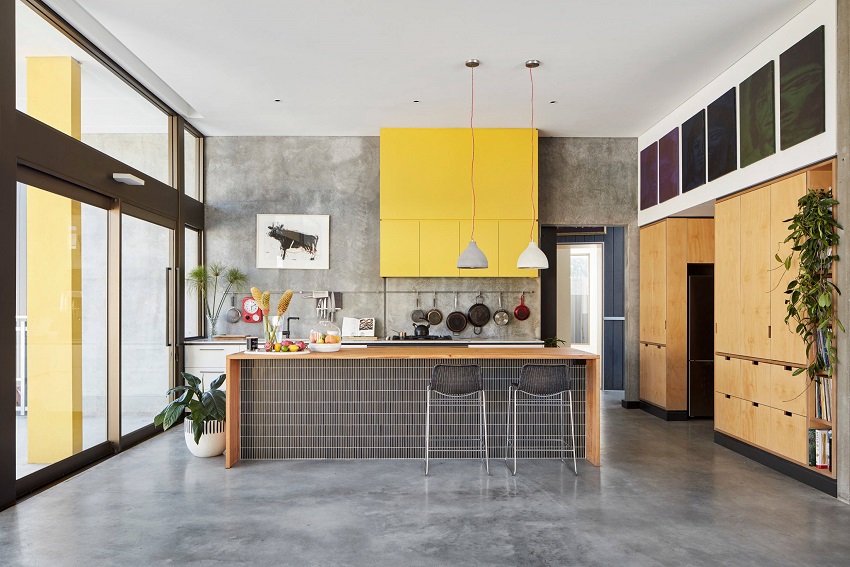
Concrete can create a continuous surface with an industrial or minimalist appearance.
Existing structural slabs may sometimes be finished, while other projects use a topping or separate flooring system.
Concrete can be:
- Polished
- Stained
- Dyed
- Textured
- Sealed with different finish systems
Its performance depends on the slab, moisture conditions, surface preparation, finish, and sealer.
Concrete is not automatically stain-proof.
Some coatings can scratch, discolor, or require periodic renewal.
Cracking should be expected and managed rather than dismissed.
Existing cracks, control joints, moisture movement, and structural conditions need professional assessment.
Concrete is hard underfoot and unforgiving to dropped glassware.
Rugs or standing mats may improve comfort, but their backing must be compatible with the finish.
Cork Kitchen Flooring
Cork offers a softer and warmer feel than tile, stone, or concrete.
Its resilience may improve comfort during long periods of standing.
Potential advantages include:
- Comfort underfoot
- Reduced impact noise
- Natural visual texture
- Some insulation value
Possible disadvantages include:
- Indentation from heavy or narrow furniture feet
- Damage from standing water
- Fading or color change from light exposure
- Product-specific sealing and maintenance
Confirm that the particular cork product is approved for kitchens.
Protect it from appliance leaks and follow the stated refinishing or resealing schedule.
Linoleum Kitchen Flooring
Linoleum is made primarily from materials such as linseed oil, resins, fillers, and a backing.
It should not be confused with vinyl, which has a different composition.
Linoleum is available in sheets, tiles, and some plank systems.
It can provide a resilient surface and a wide choice of colors.
Seams, edges, and penetrations need careful installation.
Standing water may damage the floor or subfloor if it reaches vulnerable areas.
Use cleaning and maintenance products approved by the flooring manufacturer.
Some linoleum products have factory-applied finishes, while others may require additional treatment.
Is Glass Suitable for Kitchen Flooring?
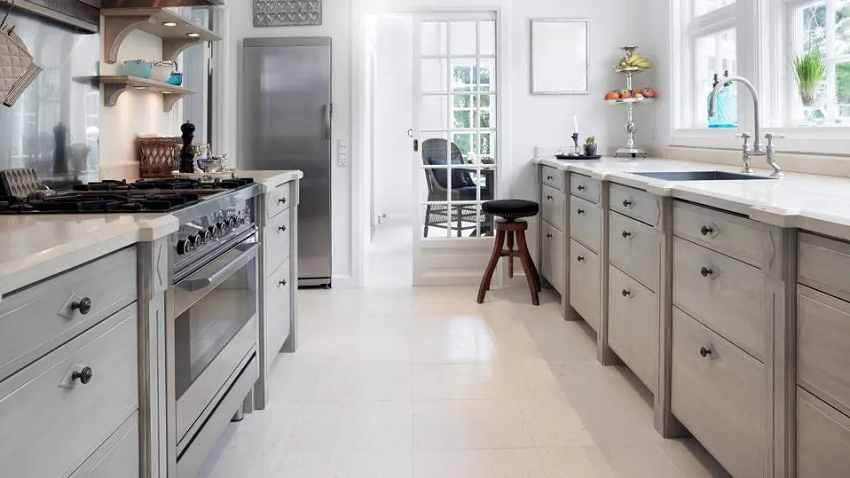
Structural glass flooring is a specialized architectural system.
It should not be treated as an ordinary alternative to tile, vinyl, or wood.
A glass floor requires engineered panels, a supporting frame, suitable edge details, a tested slip-resistant walking surface, and professional installation.
A product being described only as “tempered glass” does not prove that it is suitable as a structural floor.
Cleaning, scratching, privacy, reflections, and access beneath the glass must also be considered.
For most residential kitchens, a conventional flooring material is simpler and more practical.
Subfloor and Installation Requirements
The finished surface will only perform as well as the base beneath it.
Before installation, identify the subfloor material and condition.
Check for:
- Moisture
- Movement or deflection
- Cracks
- Uneven areas
- Loose boards
- Previous adhesives
- Height differences at adjoining rooms
- Compatibility with the proposed installation system
Tile and natural stone may require tighter limits on movement than resilient flooring.
Floating floors need expansion space and may have restrictions beneath fixed cabinets.
Older flooring, adhesives, mastics, and underlay materials may contain hazardous substances.
Do not sand, grind, or remove an unknown material until appropriate testing and work practices have been considered.
Comfort, Noise and Underfloor Heating
Tile, stone, and concrete feel firm because they provide little resilience.
This can become tiring for people who spend long periods preparing food.
Vinyl, cork, linoleum, and some wood systems generally feel less hard.
Underlay can affect comfort and sound, but it must be approved for the selected floor.
Underfloor heating can work beneath several materials.
Compatibility depends on:
- The flooring product
- The heating system
- Maximum permitted surface temperature
- Adhesive and underlay
- Subfloor construction
- Installation and operating procedures
Do not assume that every wood, laminate, vinyl, or cork product can be installed over radiant heating.
Obtain written compatibility information from both manufacturers.
Cleaning and Maintaining Kitchen Flooring
Use the cleaning method approved for the flooring and its finish.
A cleaner suitable for ceramic tile may damage natural stone, wood, cork, or a specialized concrete sealer.
General habits include:
- Remove grit before wet cleaning
- Wipe spills promptly
- Avoid leaving standing water
- Use compatible pads beneath furniture
- Protect the floor during appliance movement
- Keep suitable spare tiles or boards
- Follow sealing or refinishing instructions
Avoid assuming that vinegar is a universal floor cleaner.
Acidic products can damage marble, limestone, grout, finishes, and some sealers.
Follow product labels and keep cleaning chemicals away from children and pets.
The
EPA Safer Choice program
helps consumers identify household products whose ingredients meet its safety criteria.
The program includes floor-cleaning products.
Our
weekly cleaning schedule
can help you incorporate routine floor care without allowing kitchen residue to accumulate.
How to Choose the Best Kitchen Flooring
1. Identify the Subfloor
Determine whether the floor sits over concrete, wood framing, an existing surface, or another construction.
This will narrow the suitable materials and installation methods.
2. Consider Water Exposure
Think about spills, plumbing, dishwasher connections, refrigerator water lines, and the consequences of a leak.
No finished floor removes the need to repair leaks promptly.
3. Assess Household Wear
Pets, children, wheelchairs, dining chairs, and outdoor footwear create different types of wear.
Compare scratch, stain, impact, and rolling-load performance.
4. Decide How Much Maintenance Is Acceptable
Natural stone, wood, concrete, cork, and linoleum may require specific cleaners or periodic treatment.
Include this future work in the decision.
5. Test Samples in the Kitchen
View samples in daylight and artificial light.
Kitchen color and texture may look different after the
kitchen lighting
is switched on.
Place the sample beside cabinets, countertops, wall paint, and adjoining flooring.
Check how easily crumbs, dust, water spots, and footprints are visible.
6. Compare the Complete Installed Cost
Include preparation, removal, disposal, leveling, underlay, adhesives, trims, labor, sealing, and future maintenance.
A low material price does not always produce the lowest installed cost.
7. Review the Warranty
Check whether kitchens, pets, rolling appliances, water exposure, underfloor heating, or particular cleaning products are excluded.
Keep installation and maintenance records.
Common Kitchen Flooring Mistakes
Choosing by Appearance Alone
A showroom sample does not demonstrate comfort, slip resistance, repairability, or performance during a leak.
Compare technical requirements as well as color.
Assuming “Waterproof” Protects the Subfloor
Water may move through joints, edges, penetrations, and wall gaps.
Review the complete installation system and address leaks immediately.
Ignoring Subfloor Movement
Tile, stone, and rigid finishes may crack when installed over an unsuitable base.
Have the subfloor assessed and prepared correctly.
Using the Wrong Cleaner
Acids, abrasives, strong solvents, and excess water can damage some floors.
Follow the manufacturer’s care instructions.
Choosing a Slippery Surface
Evaluate the actual flooring product and finish.
A material name alone does not determine slip resistance.
Forgetting Appliance Replacement
Plan how the refrigerator, range, and dishwasher will be removed.
Floor heights and cabinet details should not trap appliances in place.
Not Keeping Spare Material
Colors, patterns, and dimensions may change or be discontinued.
Store a reasonable quantity of matching material for future repairs.
Combining Too Many Flooring Materials
Several small flooring zones can make an open kitchen feel fragmented.
Use transitions only where they serve a practical or architectural purpose.
Frequently Asked Questions
What is the best flooring for a kitchen?
There is no single best material.
Porcelain tile and vinyl are practical for many households.
Wood, stone, concrete, cork, laminate, and linoleum may also work when correctly specified and maintained.
What is the most water-resistant kitchen flooring?
Porcelain tile and correctly installed resilient flooring can provide strong water resistance.
However, joints, edges, grout, penetrations, and the subfloor remain important.
No floor should be used to ignore an appliance or plumbing leak.
Is vinyl flooring suitable for a kitchen?
Many vinyl products are intended for kitchens.
Check wear resistance, installation requirements, seam treatment, subfloor preparation, and warranty conditions.
Can wood flooring be used in a kitchen?
Yes, but spills must be removed promptly.
Select a product and finish suitable for the location, maintain stable conditions, and understand the warranty’s moisture exclusions.
Is laminate flooring waterproof?
Some laminate products offer enhanced water resistance, but the level and duration vary.
Water can damage joints and the core when it penetrates the surface.
Review the exact product specifications.
Which kitchen floor is easiest to clean?
Smooth tile and many vinyl products are relatively easy to maintain.
Grout texture, surface embossing, finish, seams, and cleaner restrictions can change the amount of work required.
What flooring is most comfortable for standing?
Cork and resilient materials generally feel less hard than tile, stone, or concrete.
Individual comfort, underlay, footwear, and standing mats also affect the result.
Should kitchen flooring go under the cabinets?
The answer depends on the flooring and cabinet installation.
Some floating floors should not be trapped beneath fixed cabinets.
Follow the flooring, cabinet, and appliance instructions.
Can kitchen flooring be installed over an existing floor?
Sometimes, but only when the existing surface is stable, suitable, dry, clean, and within the required height and flatness limits.
An installer should assess the complete floor assembly.
Which flooring works with underfloor heating?
Tile, stone, concrete, and some wood, vinyl, laminate, cork, and linoleum products may be compatible.
Check the maximum temperature and installation requirements of both systems.
Final Thoughts
The best kitchen flooring options balance water resistance, durability, comfort, maintenance, and appearance.
Porcelain and vinyl are practical choices for many kitchens, but they are not automatically right for every subfloor or household.
Compare the complete flooring system rather than the surface material alone.
Subfloor preparation, installation, transitions, cleaning products, appliance access, and future repairs all affect long-term performance.
Choose samples only after reviewing their technical information.
A floor that suits the room’s daily demands will remain useful long after temporary design trends have changed.