Kitchen Countertop Materials: Pros, Cons and How to Choose
Quartz, granite, laminate, solid wood, porcelain, and solid-surface countertops all have different strengths and limitations. Heat resistance, stain resistance, repairability, installation requirements, and ongoing maintenance can vary considerably between materials.
This guide compares popular kitchen countertop materials and explains the practical factors to consider before making a decision.
What to Consider Before Choosing a Kitchen Countertop
Countertops occupy a large visual area, but appearance should not be the only consideration. They are working surfaces that may be exposed to water, food, oils, cleaning products, hot cookware, sharp utensils, and frequent impact.
Before comparing materials, consider:
- how often the kitchen is used;
- how much food preparation takes place on the countertop;
- whether children regularly use the kitchen;
- the amount of available counter space;
- exposure to water around sinks;
- the type of cleaning and maintenance you are prepared to perform;
- the style and color of the cabinets;
- the overall renovation budget.
It is also worth considering the countertop together with flooring, cabinets, backsplash materials, appliances, and lighting rather than choosing each element independently.
If you are planning several changes at the same time, our kitchen design trends guide explains how materials, storage, appliances, lighting, and work zones can be coordinated as part of a complete kitchen.
Quartz Countertops
Engineered quartz countertops are manufactured from mineral material combined with resins, pigments, and other components. The exact composition varies between manufacturers and product ranges.
Unlike a slab of natural stone, engineered quartz can be produced with relatively consistent colors and patterns. Products range from simple solid colors to surfaces designed to resemble marble or other natural materials.
Advantages of Quartz
- wide selection of colors and patterns;
- relatively consistent appearance;
- low routine maintenance;
- nonporous or very low-porosity surface depending on the product;
- good resistance to many common household stains;
- no routine stone sealing for many products.
Limitations of Quartz
Quartz countertops should not be treated as indestructible. High temperatures can damage or discolor some resin-based surfaces, so trivets or heat-resistant pads should be used under hot cookware.
Edges can also chip after a strong impact, particularly around sinks, dishwashers, and heavily used corners.
Always follow the manufacturer’s recommendations for cleaning products, temperature exposure, and installation.
Granite Countertops
Granite is a natural stone, so every slab has its own color, pattern, and mineral structure. This variation is one of its main visual attractions.
A granite countertop can work with both traditional and contemporary kitchens, depending on the stone, edge profile, cabinets, and surrounding materials.
Advantages of Granite
- natural appearance;
- each slab is visually distinctive;
- good durability when properly installed and maintained;
- good heat resistance compared with many manufactured surfaces;
- many available colors and patterns.
Limitations of Granite
Natural stone can be porous to varying degrees. Some granite installations may require sealing, and the appropriate maintenance schedule depends on the specific stone and sealer.
Stone is also heavy. Cabinets and supporting structures must be suitable for the installation.
Natural variation means that a small sample may not represent the complete slab. Whenever possible, inspect the actual material before fabrication.
Laminate Countertops
Laminate remains a practical option when affordability, easy cleaning, and a wide choice of finishes are priorities.
Modern laminates can imitate wood, stone, concrete, and other materials. They are commonly installed over a manufactured wood substrate.
Advantages of Laminate
- generally lower material cost than many stone surfaces;
- large selection of colors and patterns;
- relatively lightweight construction;
- easy routine cleaning;
- useful for rental properties and budget renovations;
- can work well when the kitchen may be updated again later.
Limitations of Laminate
Laminate can be damaged by excessive heat, sharp objects, and strong impacts. A cutting board should be used rather than cutting directly on the surface.
Water can also cause problems if it penetrates damaged edges, joints, or openings and reaches a moisture-sensitive substrate.
Repair options may be limited when the decorative surface is badly damaged.
Solid Wood Countertops
Solid wood can introduce warmth and natural texture into a kitchen. Depending on the design, it may be used across the complete countertop or only on an island, breakfast bar, or selected preparation area.
Advantages of Wood
- warm natural appearance;
- works with many kitchen styles;
- can often be refinished when scratched or worn;
- available in different species, tones, and grain patterns;
- can create contrast with stone or manufactured surfaces.
Limitations of Wood
Wood reacts to moisture and changes in environmental conditions. Poorly protected areas around sinks and wet zones can stain, swell, or deteriorate.
The surface treatment must be suitable for the intended use, and maintenance requirements depend on the finish.
Hot cookware should not be placed directly on the surface. Standing water should also be removed promptly.
Porcelain Countertops
Large-format porcelain slabs have become another option for kitchen work surfaces. They are manufactured at high temperatures and are available in designs that can imitate stone, concrete, metal, and other materials.
Advantages of Porcelain
- low water absorption;
- good resistance to many stains;
- good heat resistance;
- wide variety of finishes;
- resistance to UV-related color changes can make some products useful in bright spaces.
Limitations of Porcelain
Fabrication and installation require appropriate tools and experience. Edges can be vulnerable to impact, particularly with some thinner slab designs.
Printed patterns may not continue through the full thickness of every product, so exposed edges require careful planning.
Installation quality is especially important with large-format slabs.
Solid-Surface Countertops
Solid-surface materials are manufactured from mineral fillers combined with acrylic or other resins. They are available in many colors and can often be fabricated with visually discreet joints.
Advantages of Solid Surface
- consistent appearance;
- many available colors;
- smooth transitions and integrated design options;
- nonporous surface;
- some scratches and surface damage can be repaired or refinished.
Limitations of Solid Surface
These countertops can scratch and may be damaged by high temperatures. Use cutting boards and heat protection rather than placing sharp tools or hot cookware directly on the surface.
Performance varies between manufacturers, so product-specific instructions remain important.
Comparing Kitchen Countertop Materials
No single countertop material is best for every kitchen. Each option emphasizes different priorities.
For Low Maintenance
Quartz and some solid-surface products can be attractive when simple routine maintenance is important. Porcelain also has low water absorption and generally requires little routine surface treatment.
For a Natural Appearance
Granite and solid wood provide natural variation that manufactured surfaces may only imitate. The trade-off can be greater variation and additional maintenance.
For a Limited Budget
Laminate is often worth considering when the budget needs to cover cabinets, flooring, appliances, lighting, and other parts of the renovation.
A lower-cost countertop does not necessarily make the kitchen less functional. Spending should reflect how each part of the room is actually used.
For Heat Resistance
Granite and porcelain generally tolerate heat better than laminate, wood, solid surface, or resin-based engineered stone. However, using trivets is still a sensible habit with any countertop.
For Repairability
Wood and some solid-surface materials can sometimes be sanded or refinished after surface damage. Repairing chipped stone, porcelain, or laminate may be more difficult and can remain visible.
Coordinate Countertop Colors With the Kitchen
The countertop should relate to the cabinets, floor, backsplash, wall colors, and major appliances. It does not need to match them exactly.
A kitchen often looks more coherent when one or two elements provide contrast while the remaining materials create a quieter background.
For example, light cabinets can work with both pale countertops and darker contrasting surfaces. Wood cabinets may pair well with neutral stone colors, while a strongly patterned countertop may benefit from a simpler backsplash.
Our guide to kitchen color ideas provides additional guidance on coordinating the main colors and finishes in the room.
View Samples in the Actual Kitchen
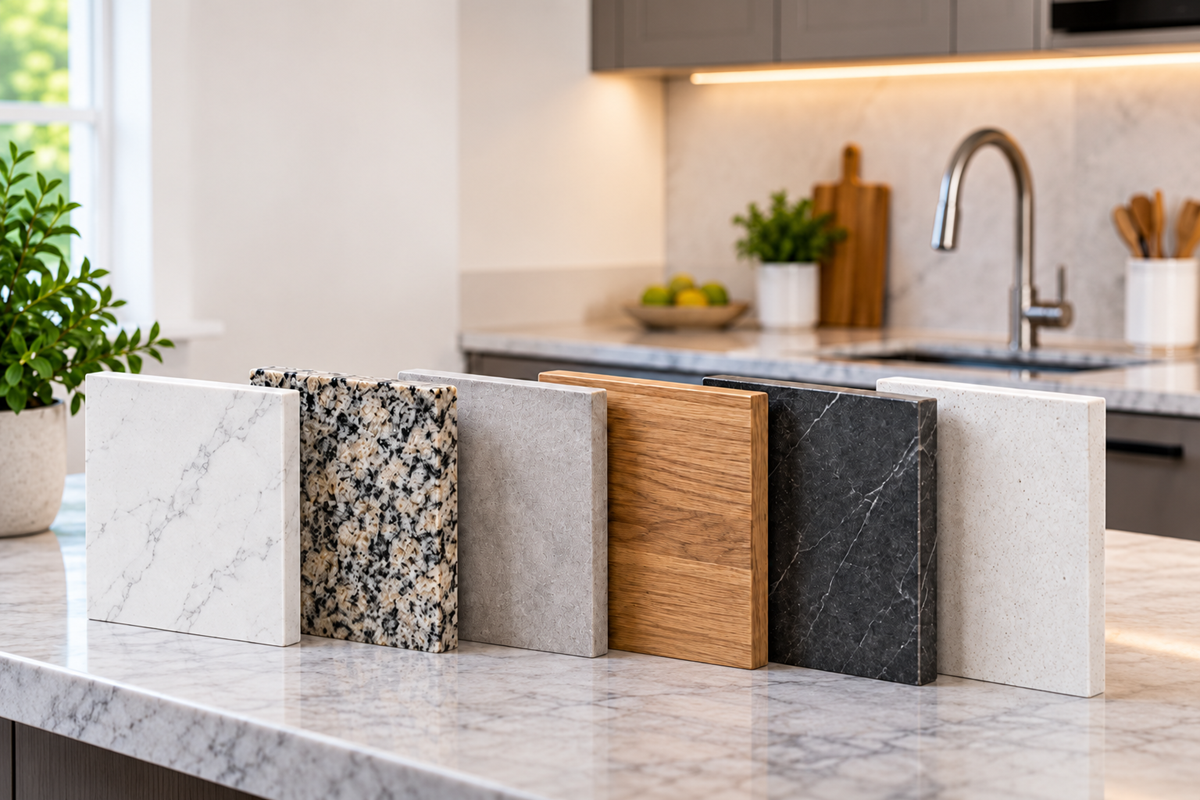
Small samples can look very different under showroom lighting. Compare materials in the kitchen during both daylight and artificial lighting.
Place samples beside cabinet doors, flooring, backsplash materials, and wall colors before making the final decision.
Cleaning and Maintaining Kitchen Countertops
Maintenance requirements should be considered before purchase rather than after installation.
Good general habits include:
- wiping spills promptly;
- using cutting boards;
- using trivets under hot cookware;
- avoiding cleaners not approved for the surface;
- keeping countertop joints and sink edges in good condition;
- following manufacturer instructions for sealing or refinishing where required.
A cleaner that is appropriate for one countertop may damage another. Natural stone, wood, laminate, quartz, porcelain, and solid surface should not automatically be cleaned in the same way.
Pay Attention Around the Sink
The area around a sink receives frequent water exposure. Check joints, sealant, cut edges, and the connection between the sink and countertop periodically.
This is particularly important when the countertop or its substrate can be damaged by prolonged moisture.
Budget for More Than the Countertop Material
The advertised price of a countertop material does not necessarily represent the final installed cost.
The complete budget may include:
- measurement or templating;
- fabrication;
- delivery;
- installation;
- sink and faucet cutouts;
- edge profiles;
- backsplashes;
- support for overhangs;
- removal of the previous countertop;
- plumbing disconnection and reconnection;
- cabinet reinforcement or adjustment.
Complex shapes, large islands, unusual edges, and difficult access can also affect installation cost.
When upgrading more than the work surface, consider the countertop as part of the complete renovation rather than consuming too much of the budget on one feature.
How to Choose the Right Kitchen Countertop Material
Start by identifying the practical requirements of the kitchen rather than selecting a material from photographs alone.
1. Define How the Countertop Will Be Used
A household that cooks frequently may prioritize durability, easy cleaning, and generous preparation space. A lightly used kitchen may place greater emphasis on appearance.
2. Decide How Much Maintenance Is Acceptable
If regular sealing, oiling, or refinishing is unlikely to happen, choose a material with maintenance requirements that better match your routine.
3. Compare Complete Installed Costs
Compare quotations that include fabrication, cutouts, edges, installation, and other necessary work rather than comparing slab prices alone.
4. Inspect Real Samples
Colors and patterns can change dramatically under different lighting. Natural stone can also vary considerably from one slab to another.
5. Coordinate With the Rest of the Kitchen
Consider the countertop together with cabinets, flooring, lighting, appliances, and storage. Our kitchen flooring guide can help when coordinating practical floor and countertop materials.
6. Check the Warranty and Care Instructions
Before purchase, read the manufacturer’s documentation. Confirm which cleaning products, temperature limits, installation methods, and maintenance procedures apply to the selected product.
Common Countertop Selection Mistakes
- Choosing from appearance alone: consider maintenance, durability, and everyday use.
- Ignoring heat limitations: some surfaces can discolor, scorch, or otherwise suffer heat damage.
- Cutting directly on the countertop: use a cutting board to protect both the surface and knives.
- Assuming every stone is maintenance-free: natural stone requirements vary.
- Ignoring water around sinks: joints and exposed substrate can become vulnerable to moisture.
- Comparing only material prices: fabrication and installation can substantially affect the total cost.
- Choosing from a tiny sample: pattern and color can look different across a complete slab.
- Forgetting cabinet support: heavy surfaces require suitable cabinetry and installation.
- Using unsuitable cleaners: follow the care instructions for the specific material.
- Following trends without considering the room: the countertop should suit both the kitchen and the household.
Frequently Asked Questions
What is the best kitchen countertop material?
There is no single best material for every kitchen. Quartz, granite, laminate, wood, porcelain, and solid surface offer different combinations of appearance, maintenance, durability, repairability, and cost.
What is the easiest kitchen countertop to maintain?
Engineered quartz, porcelain, and solid-surface materials can offer relatively simple routine maintenance, but care requirements vary by product. Always follow the manufacturer’s instructions.
Is quartz better than granite?
Neither is universally better. Quartz generally offers a more consistent appearance and low routine maintenance, while granite provides natural variation and good heat resistance. The better choice depends on the kitchen and the owner’s priorities.
Are laminate countertops a good option?
Laminate can be a practical and economical choice. It provides many colors and patterns and is easy to clean, but it needs protection from high heat, sharp objects, and moisture entering damaged joints or edges.
Are wood countertops difficult to maintain?
Maintenance depends on the wood and finish. Wood requires appropriate protection from moisture and heat, but some surfaces can be sanded and refinished when they become worn.
Are porcelain countertops durable?
Porcelain offers low water absorption and good resistance to heat and many stains. Edges can still be damaged by impact, and fabrication and installation should be performed correctly.
Should countertops match kitchen cabinets?
They do not need to match. Coordinating undertones, contrast, pattern, and surrounding materials is usually more important than using identical colors.
Can I put hot pans directly on a kitchen countertop?
Using a trivet or heat-resistant pad is the safer approach regardless of the material. Heat tolerance varies, and thermal shock or prolonged high temperatures can damage some surfaces.
Should the countertop be chosen before the flooring?
There is no mandatory order, but cabinets, countertops, flooring, backsplash, and wall colors should be considered together before final purchases are made.
How can I reduce the cost of new kitchen countertops?
Compare complete installed prices, keep the layout relatively simple, avoid unnecessary edge treatments, and consider using a premium material only on a focal area such as an island while using a more economical surface elsewhere.
Final Thoughts
The right kitchen countertop material is the one that fits the way the kitchen is used. Quartz offers convenient maintenance, granite provides natural variation, laminate can control costs, wood adds warmth and repairability, porcelain combines low water absorption with good heat resistance, and solid surface provides flexible design options.
Before choosing, compare real samples, maintenance requirements, installed costs, heat and moisture exposure, and how the surface works with the cabinets and flooring.
A countertop should not only look good on installation day. It should remain practical for everyday cooking, cleaning, and maintenance for years to come.