Matter vs Thread vs Zigbee: What’s the Difference for a Smart Home?
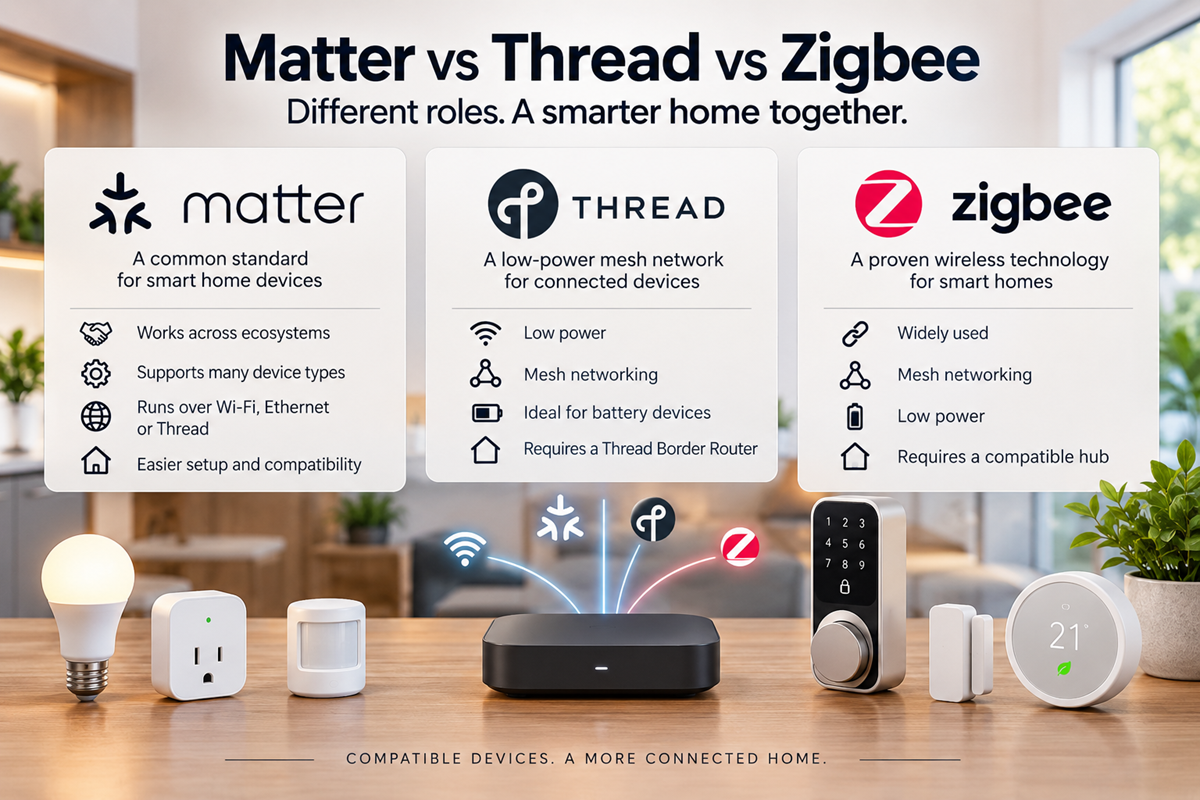
Matter, Thread and Zigbee are frequently mentioned together when choosing smart home devices, but they do not perform exactly the same job. Zigbee is a wireless communication technology widely used by smart home products, while Thread provides a low-power IP-based mesh network. Matter is an application-layer standard designed to help compatible devices work across different smart home ecosystems.
Understanding these differences can make it easier to choose smart bulbs, sensors, locks, thermostats and other connected devices without building a system around incompatible technologies.
This guide compares Matter vs Thread vs Zigbee, explains the role of hubs and border routers, and looks at compatibility, range, power consumption and everyday smart home use.
Matter, Thread and Zigbee: The Main Difference
The easiest way to understand these technologies is to separate the communication network from the language devices use to interact.
Zigbee provides both a wireless networking technology and an established application framework used by many smart home devices.
Thread is a low-power wireless mesh networking protocol based on IPv6. It provides connectivity between devices but does not, by itself, define all of the smart home commands those devices should understand.
Matter operates at a higher level. It defines how compatible smart home devices communicate and behave across supported platforms. Matter can operate over technologies including Ethernet, Wi-Fi and Thread.
This means that Matter and Thread are not competing technologies in the same sense. A smart device can use Matter over Thread, with Thread providing the network and Matter providing the common application language.
Zigbee, meanwhile, continues to be used by a large installed base of smart home devices and normally connects to IP-based home networks through a compatible hub or bridge.
What Is Matter?
Matter is a smart home interoperability standard developed through the Connectivity Standards Alliance with participation from many technology and smart home companies.
Its main purpose is to make compatible devices easier to use across different ecosystems.
Instead of a manufacturer developing completely separate implementations for every smart home platform, a Matter-certified product can use a common standard supported by participating ecosystems.
What Matter Does
Matter defines how supported device types communicate and expose their functions. Depending on the device and platform, this can include controls for lights, plugs, locks, thermostats, sensors and other smart home products.
Matter uses IP networking and can operate over:
- Wi-Fi;
- Ethernet;
- Thread.
Bluetooth Low Energy may also be used during the commissioning process, but it is not the normal operational network for Matter devices.
Advantages of Matter
- designed for interoperability between participating smart home ecosystems;
- IP-based communication;
- local communication is supported for many functions;
- standardized device commissioning;
- can operate over Wi-Fi, Ethernet or Thread depending on the device;
- reduces dependence on completely separate proprietary integrations.
Limitations of Matter
Matter does not automatically make every smart home device compatible with every feature of every platform.
Support depends on the Matter specification version, device category, manufacturer implementation and capabilities provided by the smart home platform.
Some manufacturer-specific features may still require the manufacturer’s own application.
What Is Thread?
Thread is a low-power wireless mesh networking protocol designed for connected devices. It is based on IPv6 and uses IEEE 802.15.4 radio technology.
Thread is particularly useful for devices that do not need the bandwidth of Wi-Fi, such as sensors, smart locks and other relatively low-data smart home products.
Thread Creates a Mesh Network
Compatible mains-powered Thread devices can help form the mesh and pass network traffic between devices. This can extend coverage and provide multiple possible communication paths.
Battery-powered devices are typically designed to minimize energy consumption and do not perform the same routing role as permanently powered devices.
What Is a Thread Border Router?
A Thread Border Router connects a Thread network with other IP networks in the home, such as Ethernet or Wi-Fi.
A border router may be integrated into another product. Depending on the ecosystem and model, compatible smart speakers, displays, routers or dedicated hubs may provide Thread Border Router functionality.
This distinction is important: a device advertised as a smart home hub is not automatically a Thread Border Router, and not every Thread Border Router performs the same smart home controller functions.
Advantages of Thread
- low-power operation;
- mesh networking;
- IPv6-based communication;
- designed for connected devices;
- does not depend on a single central radio hub for communication within the mesh;
- well suited to many battery-powered smart home products.
Limitations of Thread
Thread alone does not provide the complete smart home application layer. A Thread device still needs an application protocol, such as Matter, to define interoperable smart home functions.
A Thread Border Router is also required to connect the Thread network to the broader IP network.
What Is Zigbee?
Zigbee has been widely used in smart homes for many years. Like Thread, it uses IEEE 802.15.4 radio technology and is designed for low-power, relatively low-data communication.
It is commonly found in:
- smart bulbs;
- motion sensors;
- door and window sensors;
- smart plugs;
- buttons and switches;
- temperature and humidity sensors;
- water leak detectors;
- other home automation devices.
Zigbee Usually Uses a Hub or Coordinator
A typical Zigbee smart home includes a coordinator, often integrated into a smart home hub or bridge.
The hub manages the Zigbee network and can provide a connection between Zigbee devices and the home’s Ethernet or Wi-Fi network.
If you want a deeper explanation of this role, see our smart home hubs guide.
Advantages of Zigbee
- mature smart home technology;
- low power requirements;
- mesh networking;
- large range of existing smart home products;
- well suited to sensors, lights, switches and plugs;
- a local hub can allow many automations to operate without depending entirely on cloud services.
Limitations of Zigbee
Zigbee devices normally require a compatible coordinator or hub. Compatibility between products has also historically depended on device profiles, manufacturer implementation and hub support.
A product using Zigbee is therefore not automatically guaranteed to expose every feature through every Zigbee hub.
Matter vs Thread vs Zigbee Comparison
| Feature | Matter | Thread | Zigbee |
|---|---|---|---|
| Main role | Smart home application standard | IP-based wireless network | Wireless mesh and smart device ecosystem |
| IP based | Yes | Yes | Not directly |
| Mesh networking | Depends on transport | Yes | Yes |
| Low-power devices | Yes, particularly over Thread | Yes | Yes |
| Wi-Fi use | Can operate over Wi-Fi | No | No |
| Special network device | Matter controller may be required | Thread Border Router for connection to other IP networks | Zigbee coordinator or hub |
| Typical uses | Cross-platform smart home control | Network for low-power IP devices | Lights, sensors, plugs, switches and automation |
The most important point is that these columns do not represent three identical alternatives. Matter can use Thread as its network transport, while Zigbee provides its own established networking and application ecosystem.
Smart Home Hubs, Matter Controllers and Thread Border Routers
One of the most confusing parts of modern home automation is that a single physical device may perform several different roles.
For example, depending on its hardware and software, a smart speaker or hub could potentially function as:
- a smart home controller;
- a Matter controller;
- a Thread Border Router;
- a Zigbee coordinator;
- or a combination of these.
However, these capabilities should never be assumed simply because a product is called a hub.
Matter Controller
A Matter controller is used to commission and control Matter devices within a smart home ecosystem.
Thread Border Router
A Thread Border Router connects the Thread mesh to other IP networks.
Zigbee Coordinator
A Zigbee coordinator establishes and manages a Zigbee network. In consumer smart homes, this function is commonly built into a hub or bridge.
Before buying a hub, smart speaker or router specifically for home automation, check its specifications for the exact protocols and controller functions it supports.
Range and Mesh Networking
Both Thread and Zigbee use mesh networking, but actual range cannot be reduced to one reliable number.
Wireless performance depends on:
- building materials;
- walls and floors;
- device placement;
- radio interference;
- the number and position of routing devices;
- antenna design;
- the surrounding wireless environment.
Why Mains-Powered Devices Matter
In a mesh network, appropriately designed mains-powered devices can help relay traffic. Adding well-positioned routing devices can therefore improve the network topology.
Battery-operated sensors generally prioritize power conservation and should not be expected to extend the mesh in the same way.
2.4 GHz Interference
Thread and Zigbee commonly operate in the 2.4 GHz band, which is also heavily used by Wi-Fi and other wireless technologies.
Good placement and sensible network planning can therefore be important in homes with many connected devices.
Matter vs Thread vs Zigbee: Power Consumption
Power consumption is especially important for locks, contact sensors, leak detectors and other battery-operated devices.
Thread and Zigbee were designed with low-power devices in mind. This makes them useful where running a power cable is impractical.
Matter itself does not determine the radio’s energy consumption because Matter can operate over different network technologies.
For example, a Matter device using Thread has different networking characteristics from a Matter device connected directly through Wi-Fi.
Battery life ultimately depends on the complete device design, including its radio behavior, sensors, processor, reporting frequency, battery capacity and software.
Which Smart Home Devices Use Matter, Thread or Zigbee?
The best technology depends partly on the type of device and the manufacturer’s implementation.
Smart Locks
Low-power networking is particularly useful for battery-powered door locks. Depending on the model, smart locks may use Thread, Zigbee, Wi-Fi, Bluetooth or combinations of several technologies.
Our smart door locks guide explains compatibility, security considerations and installation in more detail.
Smart Thermostats
Thermostats can use several connectivity technologies depending on the manufacturer and heating system. Protocol support should be considered alongside electrical and HVAC compatibility.
See our smart thermostats guide before choosing a thermostat based on connectivity alone.
Smart Plugs
Smart plugs are permanently powered, which can make them useful network devices in some mesh implementations. Models are available using Zigbee, Wi-Fi, Thread and Matter-compatible technologies.
Our smart plugs guide covers their uses, energy monitoring and setup considerations.
Water Leak Detectors
Leak detectors are often battery powered and may remain inactive for long periods before sending an alert. Low-power wireless communication can therefore be particularly useful.
Placement can be just as important as connectivity. See our smart water leak detector guide for practical installation locations.
Smart Lighting
Lighting is one of the areas where Zigbee has traditionally been particularly common. Newer lighting products may also support Matter through Wi-Fi or Thread, depending on their design.
For more information about bulbs, switches and lighting controls, see our smart home lighting guide.
Which Should You Choose: Matter, Thread or Zigbee?
Choosing a smart home system should start with the devices and functions you need rather than the protocol name printed on the box.
Choose Matter When Cross-Platform Compatibility Is Important
Matter can be attractive when you want compatible devices to work across participating smart home ecosystems without relying entirely on separate proprietary integrations.
Check that the particular device category and functions you need are supported by both the device and your preferred platform.
Choose Thread for Low-Power IP Mesh Devices
Thread is particularly relevant when buying Matter devices such as sensors or other low-power products that benefit from mesh networking.
Make sure your home has a compatible Thread Border Router.
Keep Zigbee When It Already Works Well
A functioning Zigbee network does not need to be replaced simply because newer standards are available.
If your existing lights, plugs, sensors and switches are reliable and supported by your hub, continuing to use them may be more practical than replacing working devices.
Compatibility Is More Important Than Protocol Popularity
Before purchasing any device, verify:
- which protocol it actually uses;
- whether a hub or border router is required;
- whether your existing controller supports it;
- which features are available through your preferred platform;
- whether important functions operate locally or depend on cloud services;
- how firmware updates are delivered.
Can Matter, Thread and Zigbee Work Together?
Yes. A modern smart home can contain all three technologies.
For example, a home might have older Zigbee bulbs and sensors connected through a Zigbee hub while newer devices use Matter over Thread. Other Matter devices could connect through Wi-Fi.
The user may still control many of these products from the same smart home interface when the necessary hubs, bridges, controllers and ecosystem integrations are available.
This makes gradual upgrades possible. Building a smart home does not necessarily require replacing every existing device whenever a new standard appears.
Bridges Can Extend the Life of Existing Devices
Some manufacturers can expose supported devices connected to their existing bridges to Matter ecosystems. Availability and supported features depend on the manufacturer and product.
This approach can help integrate established device networks without requiring every individual device to contain native Matter hardware.
Frequently Asked Questions
Is Matter the same as Thread?
No. Matter is an application-layer smart home standard, while Thread is an IP-based wireless mesh networking protocol. Matter can operate over Thread.
Does Matter replace Zigbee?
Not directly. Existing Zigbee devices can continue to operate through compatible hubs and bridges. Matter provides another approach to interoperability and can coexist with established Zigbee networks.
Does Matter require a hub?
The requirements depend on the device and smart home ecosystem. A Matter controller is needed for commissioning and control, and Matter-over-Thread devices also need access to a Thread Border Router. These functions may already be integrated into other products in the home.
Does Thread require a hub?
Thread devices need a Thread Border Router to communicate between the Thread mesh and other IP networks. The border router may be integrated into a smart speaker, router, hub or another compatible device.
Does Zigbee require a hub?
A Zigbee network requires a coordinator. In typical consumer installations, the coordinator is integrated into a hub or bridge.
Is Thread better than Wi-Fi for smart home devices?
They are designed for different requirements. Thread is well suited to low-power, low-data mesh devices, while Wi-Fi offers higher bandwidth and direct IP connectivity that can be useful for other types of products.
Can Zigbee devices connect directly to Matter?
A conventional Zigbee device does not become a native Matter device simply because Matter is present in the home. However, some compatible bridges can expose supported Zigbee devices to Matter ecosystems.
Do I need to replace my Zigbee devices?
Not if they continue to meet your needs. A reliable existing Zigbee installation can remain useful while Matter and Thread devices are added gradually.
Is Matter always local?
Matter supports local IP communication, but a complete smart home system may still use internet services for remote access, manufacturer-specific features, voice assistants, updates or other functions.
Which protocol is best for a new smart home?
There is no single protocol that is ideal for every device. Check device compatibility, controller requirements, local control, power needs and ecosystem support. A practical home may use Matter, Thread, Zigbee and Wi-Fi together.
Final Thoughts
The difference between Matter, Thread and Zigbee becomes much clearer once their roles are separated. Matter provides a common application standard for compatible smart home products, Thread provides a low-power IP mesh network, and Zigbee remains an established wireless mesh technology used by a large range of existing devices.
For a new smart home, Matter and Thread can simplify interoperability and low-power networking, while Zigbee remains useful for many lights, sensors, switches and other devices already on the market or installed in homes.
Rather than choosing a home automation system around one protocol alone, check the requirements of each device, the controllers already available in your home and the features supported by your preferred ecosystem.