Kitchen Appliance Garage Ideas: How to Hide Small Appliances
An appliance garage is a dedicated cabinet or storage compartment designed to conceal small kitchen appliances when they are not being used. It may feature retractable doors, a roll-up door, lift-up hardware, or conventional cabinet doors that match the surrounding cabinetry.
Whether you are planning a complete renovation or improving an existing kitchen, this guide explains different appliance garage designs, practical dimensions, installation considerations, and important safety rules.
What Is a Kitchen Appliance Garage?
A kitchen appliance garage is a storage compartment that keeps small appliances out of sight when they are not needed. Unlike a traditional cupboard designed for dishes or food, an appliance garage is usually positioned close to the worktop so appliances remain convenient to access.
Some designs sit directly on the countertop between upper and lower cabinets. Others are integrated into tall pantry cabinets or built into a dedicated breakfast station.
Typical appliances stored in these compartments include:
- Coffee makers and espresso machines
- Toasters and compact toaster ovens
- Blenders and food processors
- Electric kettles
- Stand mixers
- Rice cookers
- Compact air fryers
- Other frequently used small appliances
Not every appliance is suitable for operation inside a cabinet. Storage and operation must be considered separately, particularly for equipment that generates substantial heat or steam.
Benefits and Drawbacks of an Appliance Garage
Before installing an appliance garage, consider how it will affect your kitchen’s appearance, storage capacity, and daily routines.
Advantages
- Cleaner appearance: concealed appliances create a more streamlined visual design.
- Better organization: small appliances can have dedicated storage locations.
- Convenient access: frequently used machines remain close to the preparation area.
- Coordinated cabinetry: matching doors help the compartment blend into the kitchen.
- Flexible design: compartments can be adapted for coffee stations, breakfast preparation, or general appliance storage.
Possible disadvantages
- Custom cabinetry and specialized door mechanisms can be expensive.
- A countertop appliance garage occupies valuable worktop space.
- Some door systems require additional clearance.
- Electrical installation may require professional work.
- Heat-producing appliances may need to be moved outside the compartment before use.
An appliance garage does not automatically increase total storage space. Its main advantage is making appliances easier to conceal and organize.
Best Kitchen Appliance Garage Ideas
The ideal design depends on the available space, the type of appliances you own, and how often you use them.
1. Countertop Appliance Garage
A countertop appliance garage is positioned directly on the kitchen worktop, usually beneath upper cabinets or at the end of a cabinet run.
This arrangement keeps small appliances at a convenient height and allows them to remain close to their normal working area.
It is particularly useful for coffee makers, blenders, and other equipment used regularly.
The main drawback is that the cabinet permanently occupies part of the countertop. Measure the remaining preparation space before choosing this layout.
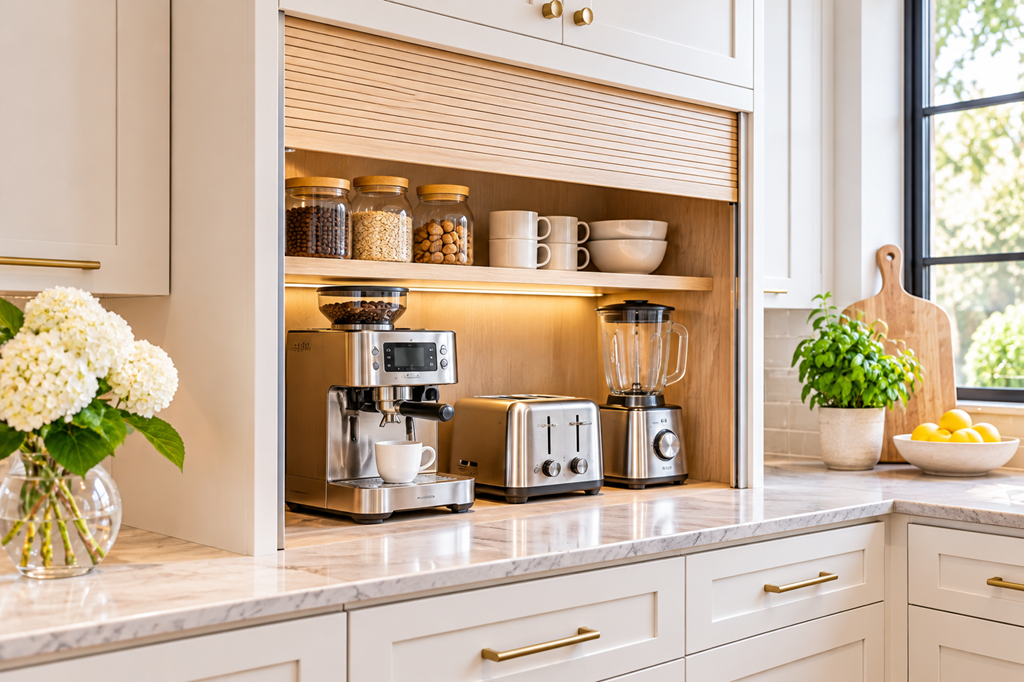
2. Roll-Up Door Appliance Garage
A roll-up or tambour door moves upward along tracks instead of swinging outward. The door typically retracts into the cabinet structure.
This design works well in kitchens where ordinary cabinet doors would interfere with nearby countertops or walking space.
Tambour doors can complement traditional kitchens, while modern finishes make them suitable for contemporary interiors.
Check the quality of the mechanism and tracks, because these components will be used frequently.
3. Hidden Appliance Garage With Pocket Doors
Pocket doors open and slide into recesses along the sides of the cabinet.
When fully retracted, they provide an unobstructed opening that makes appliances and accessories easier to reach.
This arrangement is attractive in modern kitchens because the doors almost disappear when open.
However, pocket-door hardware requires additional cabinet space and careful installation. It is generally easier to incorporate during a kitchen renovation than to retrofit into a narrow existing cabinet.
4. Lift-Up Cabinet Doors
Lift-up doors move upward rather than opening sideways.
They are useful when nearby cabinets, furniture, or appliances limit the available space for conventional doors.
Some systems use assisted hinges that keep the door in its raised position while the compartment is open.
Before selecting this design, check the space above the cabinet and make sure the raised door will not interfere with shelves, lighting, or other fixtures.
5. Appliance Garage Inside a Tall Cabinet
A full-height cabinet can contain several appliance storage areas without occupying additional countertop space.
Frequently used appliances may be placed at a comfortable working height, while less frequently used items can occupy higher or lower shelves.
This configuration works especially well in kitchens with a dedicated pantry wall or floor-to-ceiling cabinets.
Heavy appliances should be stored where they can be moved safely without excessive lifting.
6. Pull-Out Appliance Shelf
A pull-out shelf allows an appliance to move forward from its storage compartment.
This can be useful for stand mixers, blenders, and other heavy equipment that would otherwise be difficult to remove.
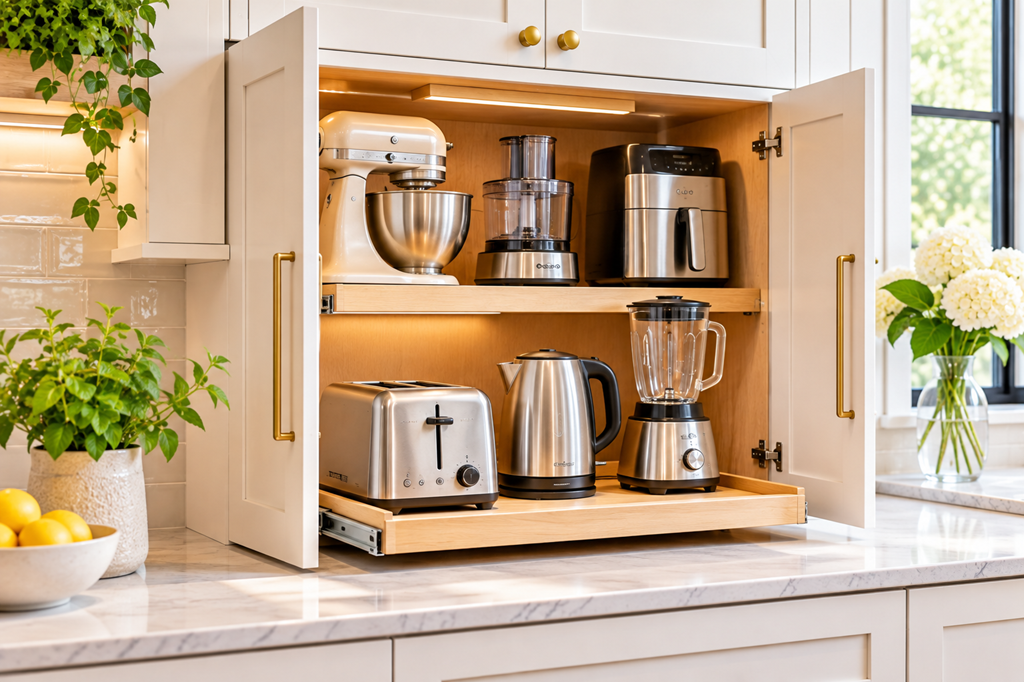
The shelf must be designed for the appliance’s weight and intended use. Some systems are designed primarily for access or storage rather than supporting an operating machine.
Check the hardware manufacturer’s load rating and installation instructions before using a pull-out system.
7. Corner Appliance Garage
Kitchen corners can be difficult to organize because the available depth is not always easy to reach.
A corner appliance garage can turn part of this space into a storage compartment for a coffee maker or small countertop appliances.
The design should provide a sufficiently wide opening so appliances can be removed without awkward lifting or twisting.
For more storage ideas, explore our kitchen cabinet organization ideas.
8. Minimalist Appliance Garage With Matching Cabinet Fronts
For a clean, contemporary appearance, use the same cabinet finish and hardware throughout the kitchen.
When the appliance garage is closed, it visually blends into the surrounding cabinetry instead of becoming a separate decorative feature.
White, warm wood, beige, and muted cabinet colors are popular choices for this understated style.
How to Create a Coffee Station Appliance Garage
A dedicated coffee station is one of the most practical uses for an appliance garage.
Instead of storing coffee equipment in different locations, you can create one organized area for making drinks.
What to include
- Coffee machine or espresso maker
- Coffee grinder
- Cups and mugs
- Coffee beans or capsules
- Tea and other drink supplies
- Spoons and small accessories
- A removable tray for cleaning
Place frequently used supplies within easy reach and reserve upper shelves for lighter items such as cups and packaged coffee.
If the machine uses a water reservoir, make sure you can refill and remove it without struggling against the cabinet walls.
Pay particular attention to steam, ventilation, and the electrical requirements of the coffee machine.
A cabinet designed specifically as a coffee station can be more convenient than a general-purpose appliance compartment, especially in households where several people prepare drinks every morning.
Kitchen Appliance Garage Ideas for Small Kitchens
Small kitchens require careful planning because cabinets and countertops are already limited.
The best solution is usually one that conceals frequently used appliances without sacrificing too much preparation space.
Choose a narrow appliance garage
A compact compartment may be sufficient for one coffee maker, blender, or small breakfast appliance.
There is little benefit in building a large cabinet when you only need to store one machine.
Use existing tall storage
If a full-height kitchen cabinet is available, consider dedicating one shelf to appliances instead of installing a separate unit on the countertop.
Consider retractable doors
Roll-up, pocket, or lift-up doors can reduce the amount of clearance required in front of the cabinet.
Keep only the appliances you use
Before investing in additional cabinetry, review the equipment you already own.
Appliances that have not been used for years may not deserve valuable kitchen storage space.
For more ways to improve limited space, read our guide on how to organize a small kitchen for maximum storage.
How to Choose the Right Appliance Garage Doors
Door design influences appearance, accessibility, required clearance, and installation cost.
| Door Type | Main Advantage | Main Consideration |
|---|---|---|
| Swing doors | Simple and familiar construction | Require space in front or beside the cabinet |
| Tambour doors | Roll away without swinging outward | Tracks and moving parts require maintenance |
| Pocket doors | Retract neatly into the cabinet | Need space for specialized hardware |
| Lift-up doors | Provide convenient front access | Require suitable overhead clearance |
| Bifold doors | Fold into a smaller opening area | Door panels and hinges can limit access |
For frequently used appliances, choose a door system that opens easily and remains safely out of the way during access.
Kitchen Appliance Garage Dimensions and Space Planning
There is no universal appliance garage size. The correct dimensions depend on the equipment, cabinet design, door mechanism, and required clearances.
Some countertop appliance garages are designed around widths of approximately 24 to 36 inches, but these figures should only be treated as planning examples rather than standard requirements.
Measure the appliances first
Record the maximum width, height, and depth of every appliance you want to store.
Remember to include:
- Handles and projecting controls
- Power cords and plugs
- Water tanks
- Removable lids
- Opening mechanisms
- Space needed for safe removal
Check the usable internal dimensions
Cabinet measurements do not always equal usable interior space. Hinges, door tracks, side panels, and other hardware may reduce the available opening.
Plan the working area
Consider where you will place an appliance when using it. Equipment that generates heat or steam may need to be moved onto an open, suitable countertop before operation.
For more inspiration on cabinet layouts and door styles, see the Houzz guide to kitchen appliance garages.
Electrical Outlets and Appliance Garage Safety
Electrical planning is one of the most important parts of an appliance garage project.
Some designs include a conveniently located outlet, while others require appliances to be unplugged and moved before operation.
However, installing an outlet inside a cabinet does not automatically make the compartment safe for operating electrical appliances.
Consider these electrical safety points
- Use outlets and circuits appropriate for the appliance’s electrical requirements.
- Do not run power cords through improvised holes or pinch them behind cabinet doors.
- Avoid using extension cords as a permanent substitute for properly installed wiring.
- Keep outlets accessible where required.
- Do not overload electrical circuits by operating several high-power appliances simultaneously.
- Check whether local electrical regulations require special outlet protection or interlocks.
In the United States, outlets inside appliance garages have specific considerations under the National Electrical Code and may not count toward required countertop receptacle outlets. Applicable rules depend on the locally adopted code edition.
Important: Ask a qualified electrician to review any new outlet, circuit, or cabinet-integrated electrical installation. Do not assume that a receptacle inside a cabinet is permitted or suitable for operating every appliance.
Ventilation, Heat, and Moisture Management
Ventilation is essential when planning storage for heat-producing or steam-producing kitchen appliances.
Coffee makers, kettles, toasters, rice cookers, air fryers, and similar equipment can release heat or moisture during operation.
Operating these appliances in an enclosed space can damage cabinetry and may create a fire or electrical hazard.
Follow the manufacturer’s instructions
Check the appliance manual for minimum clearances, ventilation requirements, and restrictions on enclosed operation.
Some appliances must not be operated inside cabinets, even with the cabinet door open.
Keep cabinet doors open when appropriate
If an appliance is specifically approved for operation within the installed compartment, follow its required ventilation and access instructions.
Never close the cabinet while a heat-producing appliance is operating unless the entire system is specifically designed and approved for that use.
Move appliances when necessary
For many toasters, air fryers, and other high-heat appliances, the safer option is to store them in the appliance garage and move them to a suitable open work surface before use.
Allow equipment to cool completely before returning it to storage.
Remember: An appliance garage is primarily a storage solution. It is not automatically a safe operating enclosure.
How Much Does a Kitchen Appliance Garage Cost?
The cost of an appliance garage varies considerably depending on its size, materials, hardware, electrical work, and whether it is installed during a renovation.
A simple cabinet modification may be much less expensive than a custom floor-to-ceiling appliance station with retractable doors.
Factors that influence cost
- Cabinet construction: stock cabinetry, modified cabinets, or fully custom units.
- Door hardware: conventional hinges are usually simpler than specialized retractable mechanisms.
- Cabinet finishes: laminate, painted wood, veneer, or premium custom finishes.
- Electrical work: additional outlets, circuits, or required safety features.
- Installation: labor costs and the complexity of fitting the unit into the existing kitchen.
- Accessories: pull-out shelves, organizers, and integrated lighting.
Rather than relying on a generic price estimate, request an itemized quote that includes cabinetry, hardware, installation, and any necessary electrical work.
If you are remodeling the entire kitchen, planning the appliance garage at the design stage may reduce the need for later modifications.
DIY Kitchen Appliance Garage Ideas
A complete custom appliance garage is not necessary for every kitchen.
There are several ways to improve appliance storage using existing cabinets or simple organizational changes.
Convert an existing cabinet into appliance storage
If the cabinet is large enough, dedicate it to lightweight or easily movable appliances.
Check shelf capacity, door clearance, and the ability to remove equipment without difficulty.
Add a sturdy pull-out organizer
A suitable pull-out shelf can make heavy or awkwardly shaped equipment easier to access.
Check the weight rating and use hardware appropriate for the cabinet construction.
Create a breakfast storage zone
Group the coffee maker, toaster, mugs, and breakfast supplies near the same work area, even if the appliances are stored behind ordinary cabinet doors.
Use removable storage baskets
Baskets can keep cords, detachable parts, coffee accessories, and small appliance attachments together.
Simple organizational improvements can make an existing kitchen feel more functional without extensive construction.
For complementary ideas, see our article on organizing a kitchen pantry.
Common Appliance Garage Mistakes to Avoid
Choosing the design before measuring the appliances
A compartment that looks spacious in a photograph may not fit your actual coffee machine, mixer, or blender.
Always measure the appliances and check usable cabinet dimensions before ordering materials.
Ignoring ventilation requirements
Heat and steam can damage cabinetry and create safety risks. Do not assume appliances can operate safely inside enclosed storage.
Installing inconvenient doors
Doors that block preparation space or collide with adjacent cabinets can make the garage frustrating to use.
Forgetting about plugs and cords
Appliance dimensions should include the space required for plugs, cords, handles, and removable parts.
Storing too many appliances
An appliance garage can become cluttered if it is used as a general storage cupboard for every kitchen gadget.
Reserve convenient space for appliances you actually use.
Choosing appearance over functionality
A visually attractive cabinet is not helpful if appliances are difficult to remove, clean, or store safely.
Alternatives to Kitchen Appliance Garages
If an appliance garage does not fit your available space or budget, there are other ways to reduce countertop clutter.
Dedicated pantry cabinet
A tall pantry cabinet can store small appliances on accessible shelves.
Rolling kitchen cart
A movable kitchen cart can provide additional storage and a flexible preparation surface.
Deep drawers
Large drawers may accommodate compact appliances or their accessories, provided the drawer system supports the weight.
Open appliance niche
An open niche can group frequently used machines in one place without the expense or complexity of concealed cabinet doors.
Reduce unnecessary equipment
Sometimes the most effective solution is simply removing duplicate or rarely used appliances.
Consider whether a multipurpose appliance can replace several specialized gadgets before adding more storage.
Frequently Asked Questions About Kitchen Appliance Garages
What is the purpose of a kitchen appliance garage?
An appliance garage provides dedicated storage for small kitchen appliances. Its main purpose is to reduce visible clutter while keeping frequently used equipment conveniently located.
Are appliance garages a good idea for small kitchens?
They can be useful, but a countertop appliance garage also occupies work surface space. In very small kitchens, storing appliances inside an existing tall cabinet may be more practical.
Can you put an outlet inside an appliance garage?
It may be possible, depending on local electrical regulations and the cabinet design. A qualified electrician should verify the installation, outlet protection, circuit requirements, and any necessary safety features.
Can you use a toaster inside an appliance garage?
Do not operate a toaster inside a cabinet unless its manufacturer explicitly approves that installation and all required clearances and safety conditions are met. Most ordinary toasters should be moved onto a suitable open countertop before use.
What is the best door style for an appliance garage?
It depends on the kitchen layout. Tambour doors are useful where outward clearance is limited, while pocket doors provide a wide opening and a streamlined appearance. Conventional hinged doors may be simpler and less expensive.
How deep should an appliance garage be?
The required depth depends on the appliances and the chosen door system. Measure the equipment, including cords and projections, and follow any manufacturer-required clearances.
Can you install an appliance garage in an existing kitchen?
Yes, some kitchens can accommodate a new appliance compartment or an adapted cabinet. The feasibility depends on available space, cabinet construction, hardware, and electrical requirements.
Does an appliance garage increase countertop space?
Not necessarily. A countertop unit actually occupies part of the worktop, but it can make the surrounding area look less cluttered. Storage inside a tall cabinet may free more usable countertop space.
Choose an Appliance Garage That Fits Your Kitchen
The best kitchen appliance garage ideas combine convenient storage, practical cabinet hardware, and a design that works with your existing kitchen layout.
Start by deciding which appliances you want to conceal, how often you use them, and whether they need to be removed before operation.
Then compare cabinet dimensions, door mechanisms, electrical requirements, and the available budget before choosing a design.
A well-planned appliance garage can make your kitchen feel calmer and more organized while keeping everyday equipment easy to access. The most successful design is not necessarily the most expensive one, but the one that fits your habits and meets the necessary safety requirements.