Benefits of a Weighted Blanket: Evidence, Safety and Buying Guide
However, individual responses vary, and research does not show that these blankets reliably treat insomnia, anxiety, ADHD, autism, or another medical condition.
A weighted blanket is heavier than ordinary bedding.
Its weight is distributed across the body through glass beads, plastic pellets, chains, layered fabric, or another filling.
Some adults find the pressure pleasant, while others feel restricted or too warm.
Safety is particularly important for children and for anyone with breathing, circulation, mobility, temperature-control, or cognitive difficulties.
What Is a Weighted Blanket?
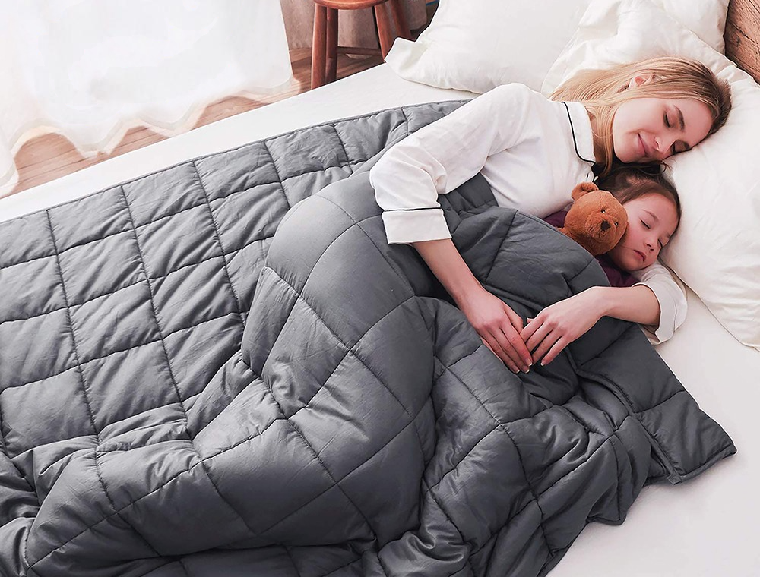
A weighted blanket is designed to apply distributed pressure across part of the body.
It is heavier than a conventional duvet, comforter, or throw.
Manufacturers create the additional weight using:
- glass beads
- plastic pellets
- metal chains
- dense layers of fabric
- other purpose-designed filling materials
Stitched pockets or channels help keep the filling distributed.
Poor construction may allow the weight to collect in certain areas.
Weighted blankets are sold for relaxation, sensory comfort, and sleep.
They are also used in some occupational therapy settings after an individual assessment.
Retail availability does not mean that a blanket is suitable for every person.
How Does a Weighted Blanket Work?
Weighted blankets are intended to provide deep-pressure input.
Users often describe the sensation as similar to firm holding or a steady hug.
Some people find this pressure calming.
Others may experience discomfort, heat, restricted movement, or anxiety.
The response cannot be predicted from body weight alone.
Articles sometimes claim that weighted blankets increase serotonin and melatonin while reducing cortisol.
Current evidence does not justify presenting this hormonal mechanism as an established fact for normal home use.
A simpler explanation is more appropriate.
The pressure may provide a sensory experience that some individuals associate with security or relaxation.
More research is needed to explain the mechanisms and identify who is most likely to benefit.
Possible Benefits of a Weighted Blanket
The word “possible” is important.
A weighted blanket may be comfortable or helpful for some people without producing the same result for everyone.
A Comforting Pressure Sensation
Some users enjoy the feeling of evenly distributed weight.
This may help them feel settled while resting, reading, or preparing for sleep.
Comfort is subjective.
A person who dislikes tight bedding may find the same pressure unpleasant.
Relaxation Before Bed
A weighted blanket can become part of a quiet bedtime routine.
The user may associate it with resting and reducing activity.
The blanket should not replace basic sleep habits.
Room temperature, light, noise, caffeine, schedule, and screen use may have a greater effect.
Possible Improvement in Perceived Sleep
Some study participants and consumers report better sleep or fewer difficulties settling.
Research results depend on the population, blanket design, study duration, and measurement method.
A subjective improvement is still meaningful to the individual.
It should not be described as proof that the blanket treats a sleep disorder.
Possible Short-Term Reduction in Anxiety
Some studies suggest that weighted blankets may reduce anxiety in limited settings.
This does not establish them as a treatment for an anxiety disorder.
Persistent or severe anxiety requires appropriate professional assessment.
A blanket should not delay medical or psychological care.
A Non-Electronic Comfort Option
A weighted blanket does not need an app, subscription, or electrical supply.
This makes it a relatively simple comfort product when it can be used safely.
It is not entirely risk-free.
The ability to move, breathe, regulate temperature, and remove the blanket remains essential.
What Does Research Say About Weighted Blankets?
Research has produced mixed and preliminary results.
Some studies report improvements in sleep or anxiety for particular groups.
Other evidence is insufficient to support broad conclusions.
A systematic review published in 2020 found only eight eligible studies.
Its authors concluded that weighted blankets might help reduce anxiety in limited circumstances.
They found insufficient evidence to recommend them for insomnia.
A 2024 review reported promising findings for sleep and related symptoms in several populations.
The authors still called for larger, higher-quality randomized trials to confirm safety and effectiveness.
One randomized study involving adults with certain psychiatric diagnoses found improved insomnia ratings with weighted chain blankets.
That result applies to the studied population and product.
It should not be generalized automatically to every consumer or blanket.
You can review the
2024 weighted blanket research review on PubMed
.
Why Research Results Differ
Studies may use different:
- blanket weights and construction methods
- participant populations
- comparison blankets
- study durations
- sleep and anxiety measurements
- supervision and clinical settings
A result from a supervised clinical study may not predict unsupervised use at home.
More evidence is needed to establish optimal weights, durations, and appropriate users.
What a Weighted Blanket Cannot Do
A weighted blanket is not a proven cure for insomnia, anxiety, ADHD, autism, restless legs syndrome, depression, or another health condition.
It should not replace:
- a medical assessment
- prescribed medication
- psychological treatment
- occupational therapy recommendations
- evaluation for sleep apnea
- evidence-based insomnia treatment
Regular difficulty sleeping can have several causes.
Examples include sleep apnea, pain, medication effects, mood disorders, restless legs, environmental problems, and inconsistent sleep habits.
Seek professional advice if sleep problems are persistent, worsening, or affecting daytime functioning.
Loud snoring, breathing interruptions, chest symptoms, severe daytime sleepiness, or sudden changes also deserve attention.
Weighted Blanket Safety
The user must be able to breathe freely, regulate body temperature, change position, and remove the blanket independently.
Never use a weighted blanket to restrain someone.
The blanket should not:
- cover the head or neck
- restrict breathing
- prevent the user from turning or sitting up
- hang so heavily over the bed that removal becomes difficult
- be wrapped tightly around the body
- be used on an unwilling person
Remove the blanket immediately if the user experiences:
- difficulty breathing
- chest discomfort
- nausea
- overheating
- numbness or pain
- increased anxiety
- difficulty moving or getting free
Who Should Seek Professional Advice First?
Ask a qualified healthcare professional before use when the person has a condition affecting:
- breathing
- heart function
- circulation
- muscle strength or mobility
- temperature regulation
- skin integrity
- alertness
- understanding or communication
Medication, illness, disability, or age may affect the ability to recognize danger or remove the blanket.
A heavier product is not automatically more therapeutic.
Are Weighted Blankets Safe for Children?
Weighted blankets require particular caution with children.
They should never be used for babies or anyone who cannot remove the blanket independently.
Guidance from NHS occupational therapy services emphasizes that a child must be supervised.
The head and neck must remain uncovered, and the blanket must never be used as restraint.
Some NHS guidance also advises removing the blanket once the child is asleep rather than leaving it in place overnight.
Parents should seek individual professional guidance instead of relying only on a retailer’s chart.
Before use, consider whether the child:
- understands how and why the blanket is being used
- wants to use it
- can remove it without help
- can communicate discomfort
- has any breathing, heart, circulation, mobility, or skin condition
- takes medication that affects alertness
The blanket should fit the child rather than the entire bed.
It should not hang heavily over the sides.
Inspect seams regularly so the filling cannot escape.
Read the
Somerset NHS weighted blanket safety guidance
before considering one for a child.
How to Choose a Weighted Blanket
Blanket Weight
Retailers commonly suggest a blanket weighing approximately 10 percent of the user’s body weight.
This is a general commercial or practical guideline, not a scientifically proven ideal for every user.
Do not automatically round up to a heavier model.
The blanket should feel comfortable and remain easy to remove.
Manufacturer limits and individual medical advice take priority.
People with limited strength, mobility, or respiratory function may need to avoid weighted blankets entirely.
A percentage calculation does not resolve those risks.
Blanket Size
Choose a blanket intended to cover the user rather than the entire mattress.
A very large blanket can become harder to move because more weight hangs over the bed.
Check both dimensions and total weight.
Two blankets with the same weight may feel different when that weight is spread over different areas.
Weight Distribution
Smaller stitched pockets can help keep beads evenly distributed.
Inspect product photographs and reviews for reports of shifting or bunching.
Uneven filling may create concentrated pressure and make the blanket less comfortable.
Strong seams are particularly important with glass or plastic filling.
Return and Trial Policy
Comfort cannot be predicted from specifications alone.
A reasonable return or trial policy can be valuable.
Check whether opened bedding can be returned.
Hygiene restrictions may apply.
Weighted Blanket Materials and Construction
Cotton
Cotton covers can feel soft and familiar.
Breathability depends on the weave, thickness, filling, and complete construction.
Polyester and Plush Fabrics
Polyester fleece or plush fabric may feel warm and soft.
It can be uncomfortable for people who already sleep hot.
Lyocell and Similar Fabrics
Some products use lyocell or blended fabrics marketed for temperature comfort.
The complete blanket construction matters more than the fiber name alone.
Glass Beads
Glass beads can provide substantial weight with relatively little bulk.
The seams and internal pockets must remain secure.
Plastic Pellets
Plastic filling may feel bulkier and can create more noticeable texture or sound.
Check the material description and washing instructions.
Metal Chains
Some therapeutic or clinical products use metal chains within padded channels.
Their feel differs from bead-filled consumer blankets.
Natural Fillings
Products filled with grains or other organic materials may be difficult to wash.
They can also be vulnerable to moisture, odors, insects, or deterioration.
Review care instructions carefully.
Removable Covers
A removable cover makes routine cleaning easier.
Check how it attaches to the inner blanket.
Weak ties may allow the insert to bunch inside the cover.
Are Weighted Blankets Suitable for Hot Sleepers?
Weighted blankets can retain more heat than ordinary bedding.
The effect depends on fabric, filling, thickness, room temperature, and other bedding.
If you tend to overheat:
- choose a less bulky construction
- use a breathable removable cover
- avoid stacking it beneath a heavy duvet
- keep the bedroom comfortably ventilated
- stop using it if you become excessively warm
Labels such as “cooling” do not guarantee that the complete product will feel cool.
A dense blanket may still retain heat even when its cover feels smooth.
Window coverings can also affect bedroom temperature and morning light.
See our guide to
off-white blackout curtains
for practical light-control information.
How to Try a Weighted Blanket Safely
Do not begin by assuming it must be used throughout the night.
A short, awake trial provides an opportunity to assess comfort and movement.
- Read the complete manufacturer instructions.
- Inspect the seams, pockets, cover, and filling.
- Lie or sit in a position where you can move freely.
- Place the blanket loosely over the body.
- Keep the head and neck completely uncovered.
- Confirm that you can remove it without assistance.
- Use it for a short supervised or awake period.
- Stop if you feel hot, restricted, anxious, numb, or short of breath.
If the first trial feels uncomfortable, do not force yourself to adapt.
A weighted blanket is optional and should not create distress.
Do not combine several weighted products.
Do not place additional heavy bedding on top unless the manufacturer and an appropriate professional consider it safe.
Cleaning and Maintaining a Weighted Blanket
Weighted blankets may exceed the capacity of a domestic washing machine when wet.
Check the total product weight and washing instructions before cleaning.
Recommended care may include:
- machine washing the removable cover
- spot-cleaning the weighted insert
- using a commercial-capacity machine
- air drying
- low-temperature drying when permitted
Do not assume that every glass-bead blanket is machine washable.
Fabric, stitching, and total weight also determine care requirements.
Inspect the blanket regularly for:
- open seams
- leaking filling
- uneven weight distribution
- damaged ties or fasteners
- odor, moisture, or mold
Stop using a damaged weighted blanket.
Loose filling can create additional risks, especially around children and pets.
Alternatives to a Weighted Blanket
A person who dislikes or cannot safely use a weighted blanket still has other comfort options.
Depending on the goal, alternatives may include:
- a regular duvet with a preferred texture
- supportive pillows
- a consistent bedtime routine
- adjusting bedroom temperature
- reducing unwanted light and noise
- relaxation or breathing exercises
- professional occupational therapy advice
- medical assessment for persistent sleep problems
A comfortable bedroom can support rest without making medical promises.
Use color, lighting, textiles, and decoration to create a calm environment.
Our
bedroom artwork guide
explains how to choose and position visual elements.
Frequently Asked Questions About Weighted Blankets
Do weighted blankets really work?
Some users and studies report improved relaxation, anxiety, or sleep outcomes.
The evidence remains limited and does not show that every user will benefit.
Can a weighted blanket cure insomnia?
No.
A weighted blanket is not an established cure for insomnia.
Persistent sleep problems should be discussed with a qualified healthcare professional.
Do weighted blankets increase serotonin or melatonin?
Claims about predictable hormonal changes are not sufficiently established for normal home use.
The proposed mechanisms require more research.
How heavy should a weighted blanket be?
Approximately 10 percent of body weight is a commonly stated guide.
It is not a universal prescription.
Comfort, removal ability, manufacturer limits, age, health, and professional advice are more important.
Can a weighted blanket be too heavy?
Yes.
A blanket that restricts breathing, movement, temperature regulation, or independent removal is unsafe.
Heavier does not mean more effective.
Can you sleep under a weighted blanket all night?
Some healthy adults choose to do so when they can remove it freely and have no relevant health concerns.
Children and vulnerable users require stricter assessment and supervision.
Follow professional and manufacturer guidance.
Can babies use weighted blankets?
No.
A weighted blanket should not be used for a baby or any person who cannot remove it independently.
Are weighted blankets safe for children?
They require individual risk assessment, supervision, informed consent, and the ability to get free without help.
Some NHS guidance advises removing the blanket once the child falls asleep.
Can a weighted blanket help with anxiety?
Some people report short-term calming effects, and limited studies suggest possible benefits.
It is not a replacement for professional treatment of an anxiety disorder.
Can a weighted blanket help with restless legs syndrome?
There is not enough evidence to recommend it as a treatment.
People with persistent leg discomfort should seek assessment for the underlying cause.
Can I use a weighted blanket if I have sleep apnea?
Seek advice from a qualified healthcare professional first.
A product that adds weight or affects movement should not interfere with breathing or prescribed sleep-apnea treatment.
Can two people share one weighted blanket?
A shared blanket may distribute weight unpredictably and be difficult for one person to remove.
Separate appropriately selected blankets provide more individual control.
Are weighted blankets washable?
Some are washable, while others require spot cleaning or commercial equipment.
Follow the specific care label and respect the washing machine’s weight limit.
Final Thoughts
A weighted blanket may provide a comforting pressure sensation and support relaxation for some users.
It should not be presented as a guaranteed solution for sleep, anxiety, or another health condition.
Choose a product that is easy to remove, appropriately sized, securely constructed, and suitable for the user’s health and mobility.
Begin with a short awake trial and stop if discomfort occurs.
Children, vulnerable adults, and people with relevant medical conditions require additional caution.
When safety or suitability is uncertain, obtain individual advice from a qualified healthcare or occupational therapy professional.