Home Theater Subwoofer: How to Choose, Place and Set It Up
It handles low-frequency effects and can also receive bass redirected from other channels.Choosing the right model requires more than checking its driver size or amplifier power. Room volume, listening distance, placement, output capability, and available controls also matter.
This guide explains how to compare subwoofers without relying on arbitrary wattage rules. It also covers connection, placement, crossover, phase, calibration, and common setup problems.
What Is a Home Theater Subwoofer?
A subwoofer is a speaker designed for low-frequency reproduction. Most home theater models are active, or powered, subwoofers.
An active subwoofer contains:
- A low-frequency driver
- A built-in amplifier
- A dedicated enclosure
- Audio inputs
- Level and phase controls
- Additional adjustment features on some models
The AV receiver decides which bass signals reach the subwoofer. This process is known as bass management.
The subwoofer may reproduce two types of information:
- The dedicated low-frequency effects channel
- Bass redirected from speakers set to Small
These signals are related, but they are not the same thing.
Do You Need a Subwoofer in a Home Theater?
A subwoofer is not technically required for every audio system. Some large speakers can reproduce a useful amount of bass.
However, a suitable subwoofer usually provides several benefits:
- Deeper bass extension
- Greater low-frequency output
- Dedicated reproduction of the LFE channel
- Less bass demand on smaller speakers
- More flexible bass placement
The AV receiver can sometimes redirect the LFE channel to large front speakers. Those speakers and their amplifier must handle the extra demand.
Compact speakers usually benefit most from a subwoofer. Their enclosures and drivers limit low-frequency performance.
A subwoofer is also useful at moderate listening levels. It does not need to shake the room to improve tonal balance.
Our separate article explains
why a good subwoofer matters
in movies, music, and games.
What Does the “.1” Channel Mean?
In a 5.1 system, the number five refers to the conventional speaker channels. The “.1” identifies the low-frequency effects channel.
The LFE channel contains selected low-frequency information from the soundtrack. Explosions and engines are common examples.
A subwoofer can also reproduce bass from the main channels. The receiver redirects this bass according to the crossover settings.
Therefore, the subwoofer output is not limited to the LFE track. It may combine LFE information with redirected bass.
In layouts such as 5.1.2, the final number identifies height channels. It does not represent additional subwoofers.
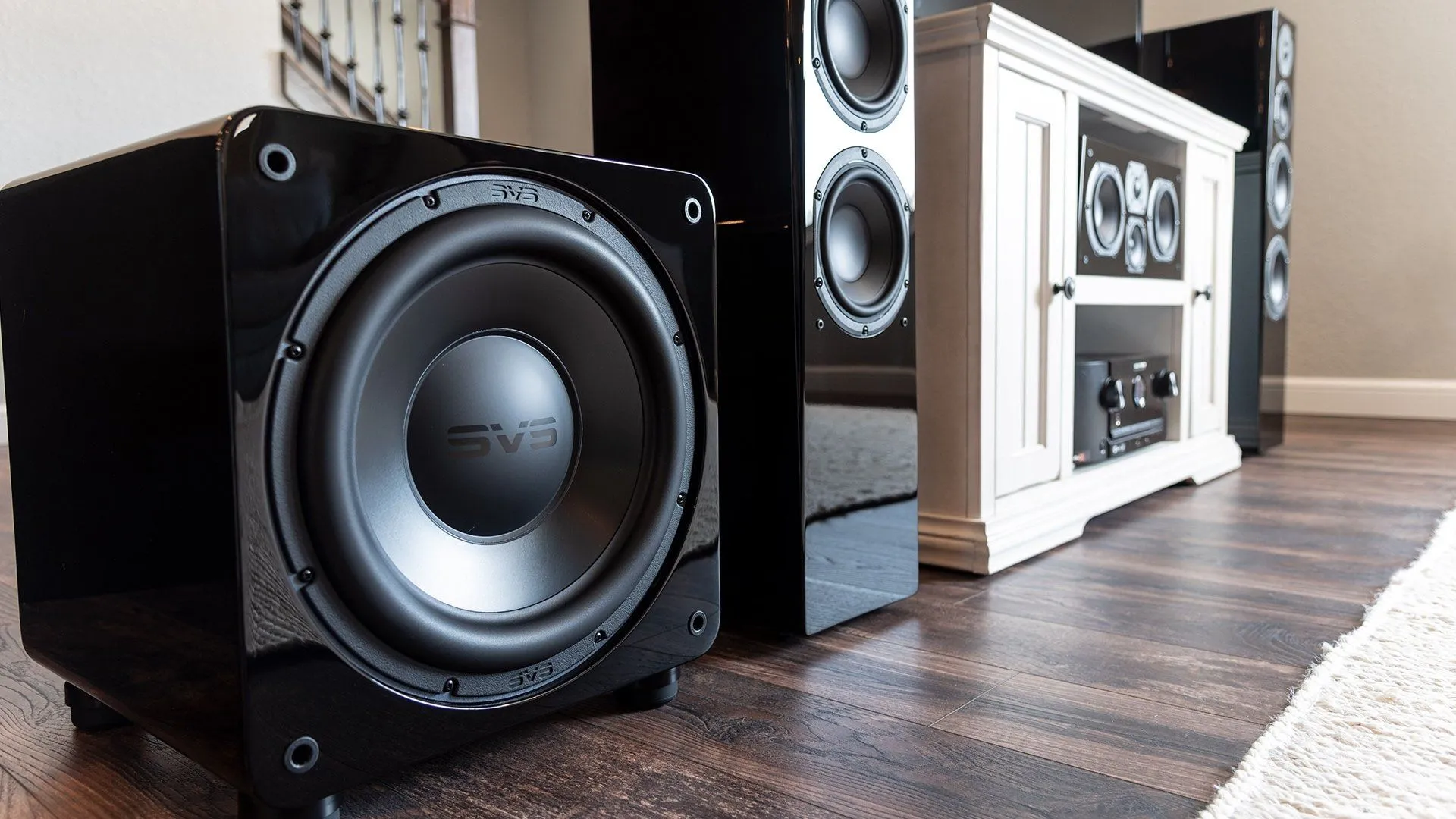
Consider the Room Before Choosing a Subwoofer
Room size affects bass output, but floor area does not tell the whole story. Ceiling height and connected spaces also matter.
An open living room may require more output than an enclosed room. Bass energy can travel into hallways, kitchens, and stairwells.
Consider:
- Total room volume
- Open doors and connected spaces
- Distance from the subwoofer to the seats
- Expected listening volume
- Number of listening positions
- Placement restrictions
- Neighbors and shared walls
A larger subwoofer is not always necessary in a small room. However, extra capability can provide cleaner bass at lower effort.
Do not select a model using room area alone. Compare its measured output and extension when reliable data is available.
Important Home Theater Subwoofer Specifications
Frequency Response
Frequency response describes the range the subwoofer can reproduce. The quoted range needs a tolerance or measurement condition to be meaningful.
A manufacturer may list a low number without explaining the output at that frequency. Compare specifications measured under similar conditions.
Maximum Output
Output describes how loudly the subwoofer can play at different frequencies. Deep bass usually demands more driver movement and amplifier power.
Independent measurements can make output comparisons easier. Marketing descriptions alone reveal little.
Amplifier Power
Powered subwoofers may list continuous and peak power. Continuous output is generally more useful for comparison.
Wattage should not be considered alone. Driver efficiency, enclosure design, limiting, and amplifier behavior also affect performance.
Inputs
A home theater subwoofer commonly provides an RCA input marked LFE or Line In. Some models include left and right line inputs.
Other possible connections include:
- Balanced XLR input
- Speaker-level input
- Wireless adapter connection
- Proprietary soundbar connection
Make sure the input matches your receiver or audio system.
Adjustment Controls
Useful controls may include:
- Output level
- Phase switch or variable phase
- Low-pass filter
- Auto standby
- Room EQ
- Parametric equalization
- Application control
Not every installation needs every feature. Receiver calibration may handle some adjustments.
Does Subwoofer Driver Size Matter?
Driver size affects how much air the subwoofer can move. However, it does not determine performance by itself.
A well-designed smaller model may outperform a poorly designed larger one. Enclosure volume and driver excursion also matter.
Amplifier capability and signal processing affect the final result. Two subwoofers with equal driver sizes can perform very differently.
Do not assume:
- A smaller driver is always faster.
- A larger driver is always deeper.
- One driver size is correct for all rooms.
- Music requires a different diameter from movies.
Compare the complete product rather than one measurement.
How Much Subwoofer Power Do You Need?
There is no universal minimum wattage for home theater. The required output depends on the room and listening level.
A power rating also does not reveal how much deep bass the system can produce. Two models with the same rating may have different limits.
Look for:
- Continuous amplifier power
- Measured low-frequency output
- Distortion control
- Protection and limiting behavior
- Performance at your listening distance
Extra amplifier capacity can provide useful headroom. It does not mean the subwoofer must always play loudly.
Avoid comparing peak numbers from one manufacturer with continuous ratings from another.
Sealed vs Ported Subwoofers
Sealed and ported subwoofers can both perform well. The result depends on the complete design and setup.
| Design | Possible advantages | Possible limitations |
|---|---|---|
| Sealed | Compact enclosure and gradual low-frequency roll-off | May need more driver movement for high output |
| Ported | Efficient output near the port tuning frequency | Usually requires a larger enclosure |
| Passive radiator | Low-frequency support without an open port | Performance depends heavily on the complete design |
| In-wall | Minimal use of visible floor space | Requires careful installation and placement planning |
A sealed design is not automatically more accurate. A ported model is not automatically suitable only for movies.
Well-designed examples of either type can work for music and home theater.
Check the Physical Size
Ported enclosures can be much larger than product photographs suggest. Measure the cabinet before ordering.
Include space for connections, ventilation, and port clearance. Follow the manufacturer’s placement instructions.
How to Connect a Home Theater Subwoofer
AV Receiver with Subwoofer Output
Most modern receivers provide a connection labeled Subwoofer Out, SUB OUT, or LFE.
- Turn off the receiver and subwoofer.
- Connect the receiver output to the subwoofer input.
- Use the LFE input when the subwoofer provides one.
- Connect power to the subwoofer.
- Turn on both devices.
- Enable the subwoofer in the receiver menu.
A shielded RCA subwoofer cable is commonly used. Long cable runs should be planned carefully.
Subwoofer with Left and Right Inputs
Consult the subwoofer manual when no dedicated LFE input is present. Some models specify one input for a mono connection.
A Y-adapter is not always required. Use one only when the manufacturer recommends it.
Wireless Subwoofer Connection
Wireless audio removes the long signal cable. The subwoofer still needs electrical power.
Some wireless subwoofers work only with a matching soundbar. They may not connect to a standard AV receiver.
Receivers with Two Outputs
Two output connectors do not always provide independent processing. They may carry the same signal.
Check whether the receiver can measure and adjust two subwoofers separately.
Where Should You Place a Home Theater Subwoofer?
Bass response changes throughout a room. A position that sounds strong in one seat may sound weak in another.
Start near the front wall. A position beside the television or front speakers is often practical.
Then test several locations. Small changes can produce a noticeable difference.
Corner Placement
A corner can increase perceived output. It may also emphasize certain frequencies too strongly.
Use corner placement as an option, not an automatic rule. Listen for uneven or lingering bass.
Wall Placement
Moving the subwoofer closer to a wall changes its response. Test several distances where space permits.
Maintain any port or amplifier clearance required by the manufacturer.
Avoid Closed Furniture
Do not place a conventional subwoofer inside a closed cabinet. The cabinet can rattle and restrict sound.
Heat from the built-in amplifier also needs a way to escape.
Use the Subwoofer Crawl
The subwoofer crawl is a practical way to identify possible locations:
- Place the subwoofer near the main listening position.
- Play a repeating bass sweep or familiar bass material.
- Move around the room at subwoofer height.
- Listen for smooth and controlled bass.
- Mark several promising locations.
- Place the subwoofer in one of those positions.
- Test again from the listening seats.
This method provides a starting point. Measurements offer more precise information when suitable equipment is available.
How to Set the Subwoofer Crossover
The crossover redirects low frequencies from the main speakers to the subwoofer. The best value depends on speaker capability and room behavior.
A common starting point is 80 Hz. Small satellite speakers may need a higher setting. Large capable speakers may support a lower crossover.
Do not choose a setting below what the speakers can reproduce cleanly.
Using an AV Receiver
When the receiver controls bass management, disable or bypass the subwoofer’s internal low-pass filter. Some models provide an LFE setting for this purpose.
If no bypass setting exists, turn the subwoofer crossover control to its highest value. Follow the product manual.
Speaker Size Settings
Receiver menus often label speakers as Large or Small. These labels refer to bass management, not physical dimensions.
Setting a speaker to Small allows bass below its crossover to reach the subwoofer.
Even floor-standing speakers may benefit from this setting. It can reduce low-frequency demand on the receiver and speakers.
Do Not Confuse Crossover with LFE Low-Pass Settings
The speaker crossover and the LFE low-pass filter have different purposes. Avoid changing the LFE setting without understanding the receiver’s instructions.
How to Adjust Subwoofer Phase and Level
Subwoofer Level
Set the subwoofer level high enough to support the system. It should not dominate every scene or music track.
Start with the receiver’s calibration result. Make small adjustments after listening to varied content.
Avoid using one bass-heavy scene as the only reference.
Phase Control
Phase affects how the subwoofer combines with the main speakers. Incorrect alignment can reduce output near the crossover region.
Some subwoofers provide a 0/180-degree switch. Others offer a variable phase control.
Begin with the manufacturer’s recommended position. Run calibration before making large changes.
Choose the setting that creates the smoothest transition around the crossover. Louder bass is not always more accurate bass.
Polarity and Phase Are Related but Different
A polarity switch reverses the electrical relationship. Variable phase changes timing over a selected range.
Product controls may use these terms differently. Consult the manual for the exact implementation.
Run Room Calibration
Many AV receivers include an automatic calibration system. It can measure speaker distance, level, crossover, and room response.
Before calibration:
- Place the subwoofer in its intended position.
- Set its initial controls as directed.
- Place the microphone at seated ear height.
- Keep the room quiet.
- Use every required microphone position.
Review the results after calibration. Confirm that the subwoofer was detected and the distances are plausible.
An unusual reported subwoofer distance is not always an error. Internal processing can add delay.
Do not move the subwoofer after calibration without running the process again.
Our
home theater setup guide
covers the rest of the system installation.
Should You Use Two Subwoofers?
Two subwoofers can provide more output. More importantly, suitable placement can improve consistency between seats.
A second subwoofer may help when:
- Several seats need balanced bass.
- The room has strong bass variations.
- One subwoofer lacks sufficient output.
- The receiver supports useful dual-sub calibration.
Two poorly positioned subwoofers are not automatically better than one correctly placed model.
Matching models can simplify setup. Different subwoofers may require more careful adjustment.
The ideal locations depend on room dimensions and seating. Measurement software can help with advanced installations.
Common Home Theater Subwoofer Problems
The Subwoofer Produces No Sound
- Confirm that it has power.
- Check the receiver cable.
- Enable the subwoofer in the receiver menu.
- Set the speakers to Small for testing.
- Check the selected listening mode.
- Increase the subwoofer level slightly.
The Subwoofer Does Not Wake Automatically
The input signal may be too low to trigger auto standby. Increase the receiver’s subwoofer output and reduce the gain control accordingly.
Use the always-on setting for testing when available.
The Bass Sounds Boomy
- Move the subwoofer away from the corner.
- Lower its output level.
- Check the crossover setting.
- Run calibration again.
- Test another listening position.
Bass Is Weak at One Seat
The seat may be in a room-related cancellation zone. Increasing the level may make other seats excessively loud.
Move the subwoofer or seating position. A second subwoofer may also improve consistency.
The Subwoofer Can Be Easily Located by Ear
The crossover may be too high. The subwoofer may also be producing distortion or cabinet noise.
Check that the main speakers can support a lower crossover before changing it.
The Subwoofer Hums
Disconnect the signal cable while leaving the subwoofer powered. If the hum stops, the connected equipment or cable path may be involved.
Keep signal cables away from power cables where practical. Do not remove protective grounding connections.
Seek qualified assistance when electrical safety is uncertain.
The Cabinet or Room Rattles
The noise may come from furniture, doors, vents, or decorative objects. Play a bass sweep at a moderate level to locate it.
Do not assume that every rattle comes from the subwoofer cabinet.
Home Theater Subwoofer Buying Checklist
- Estimate the complete room volume.
- Consider open areas connected to the room.
- Measure the available installation space.
- Check the receiver’s subwoofer outputs.
- Confirm the required input connections.
- Compare measured output when available.
- Review frequency response conditions.
- Compare continuous rather than peak power.
- Choose between sealed and ported designs.
- Check available phase and EQ controls.
- Plan several possible placement locations.
- Check warranty and local service options.
- Include cables or wireless adapters in the budget.
If you are planning a complete speaker package, see our
5.1 surround sound system buying guide.
Frequently Asked Questions
Is a subwoofer necessary for home theater?
It is not mandatory for every system. However, it usually provides deeper bass and more suitable LFE reproduction than ordinary speakers.
What size subwoofer do I need?
Driver diameter alone cannot answer this question. Consider room volume, required output, enclosure design, and measured performance.
How many watts should a home theater subwoofer have?
There is no universal minimum. Compare continuous power with output, extension, driver capability, and room requirements.
Where is the best place for a subwoofer?
The best location depends on the room and seating. Start near the front wall, then test several positions.
Is a sealed or ported subwoofer better?
Neither design is always better. Both can provide accurate and powerful bass when properly designed and configured.
What crossover should I use?
A common starting point is 80 Hz. Small speakers may need a higher crossover. Follow speaker specifications and calibration results.
Should speakers be set to Large or Small?
Use Small when you want bass below the crossover sent to the subwoofer. This can also benefit many floor-standing speakers.
Should the subwoofer crossover control be set to maximum?
Often yes when an AV receiver manages the crossover. Use an LFE or bypass mode when the subwoofer provides one.
Is one subwoofer enough?
One suitable model can work well for a main seat. Two may provide more consistent bass across several seats.
Can I place a subwoofer inside a cabinet?
A closed cabinet is generally unsuitable. It can restrict performance, trap heat, and create rattles.
Can I use a soundbar subwoofer with an AV receiver?
Usually not. Many soundbar subwoofers use proprietary wireless connections. Check the manufacturer’s compatibility information.
Final Thoughts
A home theater subwoofer should be selected as a complete system. Driver size and wattage reveal only part of its performance.
Consider room volume, output capability, enclosure design, connections, and placement. Then use bass management to integrate it with the speakers.
Start with a practical location and a suitable crossover. Run room calibration before making small level or phase adjustments.
A well-integrated subwoofer should support the soundtrack without drawing attention to itself. Smooth, controlled bass is more useful than constant excess volume.