Best Frequency Bands for Choosing a Modern 4G/5G Signal Booster
A booster that supports the wrong bands may provide little or no improvement, even if its advertised coverage area and gain appear suitable.The correct choice also depends on outdoor signal quality, building materials, antenna placement, network technology, and local regulations. Therefore, you should measure the available signal and verify legal requirements before purchasing or installing any repeater.This guide explains how mobile frequency bands work, how to identify the bands available at your property, and how to select a compatible booster without relying on oversimplified urban or rural recommendations.
Why Frequency Bands Matter When Choosing a Booster
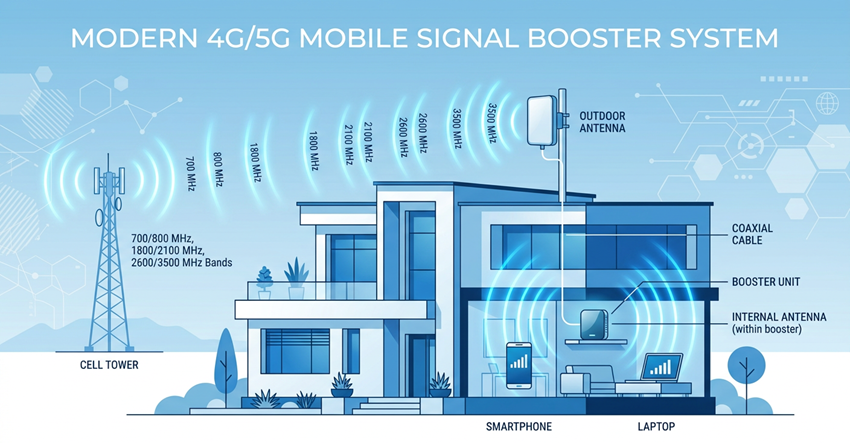
Mobile networks operate on licensed frequency bands. Each band uses a defined range of uplink and downlink frequencies for communication between phones and base stations.
A signal booster must support the bands used by your operator in the specific location where the equipment will be installed.
For example, a property may receive 4G service on a low-frequency coverage band and a higher-frequency capacity band. A single-band booster that supports only one of them will not amplify the other.
In addition, the band displayed by a phone can change throughout the day as the network manages coverage, capacity, and congestion.
Before choosing a booster, determine:
- which mobile operator or operators must be supported
- which LTE and 5G NR bands are available outdoors
- whether the network uses 5G Standalone or Non-Standalone service
- how strong and clean the outdoor signal is
- which bands carry voice and data services
- whether the proposed device is legal in your country
What to Check Before Buying a 4G 5G Signal Booster
Do not begin by choosing the booster with the largest advertised coverage area. Instead, begin with the network and the building.
Confirm Outdoor Service
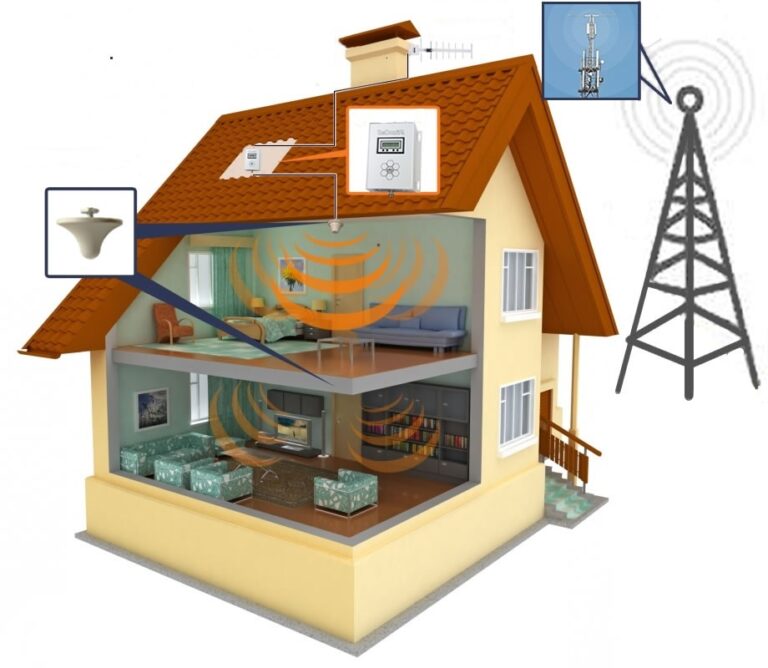
A repeater does not create a mobile network signal from nothing. It receives an existing outdoor signal, amplifies it, and retransmits it inside the building.
Therefore, test the signal outdoors at several points, including upper floors or the roof area where the donor antenna might be installed.
Identify the Required Operator
Different operators may use different bands in the same area. In addition, two phones connected to different providers may receive service from different base stations.
If several operators must be supported, confirm that the booster is legally permitted and technically designed for multi-operator use.
Inspect the Building
Energy-efficient glazing, metal roofs, reinforced concrete, foil-backed insulation, thick masonry, and metal wall cladding can weaken mobile signals.
In many cases, the outdoor signal is usable while the indoor signal is poor because the building envelope introduces substantial loss.
Define the Coverage Area
Decide whether you need coverage in one room, one floor, or an entire building.
Real indoor coverage depends on signal quality, booster output, cable loss, antenna placement, walls, and separation between antennas. Consequently, an advertised square-meter figure should be treated only as a rough estimate.
Common 4G and 5G Frequency Bands
The following table provides examples of bands used in many European and other international networks. However, it is not a universal allocation table.
The same frequency may be assigned differently in another country. Furthermore, an operator may not use every available band at every base station.
| Approximate frequency | Example LTE band | Example 5G NR band | General characteristics |
|---|---|---|---|
| 700 MHz | Band 28 | n28 | Low-frequency coverage with relatively good building penetration |
| 800 MHz | Band 20 | Varies by region | Common LTE coverage layer in parts of Europe |
| 850 MHz | Band 5 | n5 | Used for coverage in several regions outside Europe |
| 900 MHz | Band 8 | n8 | Coverage band that may support different network generations |
| 1800 MHz | Band 3 | n3 | Widely used mid-band spectrum with a balance of coverage and capacity |
| 2100 MHz | Band 1 | n1 | Used for LTE, 5G, or legacy services depending on the operator |
| 2600 MHz | Band 7 | n7 in supported networks | Higher-capacity spectrum with shorter reach and greater building loss |
| 3.3–3.8 GHz | Not a common LTE coverage layer | Commonly associated with n77 or n78 | Important 5G capacity spectrum with more limited indoor penetration |
| Millimeter wave | Not applicable | Examples include n257, n258 and n260 | Very high capacity over relatively short distances in selected deployments |
Always compare a booster’s complete supported-band specification with the bands used by the target operator. A description such as “supports 700 MHz” is not enough unless the device supports the correct uplink, downlink, bandwidth, duplex method, and regulatory requirements.
Low, Mid and High Mobile Frequencies
Low-Frequency Bands
Lower-frequency bands generally travel farther and penetrate buildings more effectively than higher-frequency bands under similar conditions.
Consequently, operators often use low bands as coverage layers in rural areas and inside buildings.
However, low frequency does not automatically mean fast data. Available bandwidth, network load, radio conditions, and carrier aggregation also affect performance.
Mid-Frequency Bands
Bands around 1800 MHz, 2100 MHz, and 2600 MHz are often used to balance coverage and capacity.
These bands may provide strong performance when the base station is reasonably close and the outdoor signal is good. Nevertheless, thick walls and energy-efficient glazing can reduce indoor reception.
3.5 GHz 5G Spectrum
Spectrum around 3.5 GHz is widely associated with high-capacity 5G deployments. It can provide substantial bandwidth, but it generally has more difficulty penetrating buildings than lower-frequency coverage bands.
Supporting this spectrum in a repeater may also be technically and legally more complicated because many networks use time-division duplexing.
Millimeter-Wave 5G
Millimeter-wave service uses much higher frequencies and is available only in selected markets and locations.
Its short range and sensitivity to obstacles make conventional wide-area indoor boosting difficult. Therefore, do not assume that a product supports millimeter-wave 5G simply because it is advertised as a “5G booster.”
How to Identify the Bands Used at Your Property
Band selection should be based on measurements taken at the actual installation location.
Check the Operator’s Coverage Information
Begin with your operator’s official coverage map and support information. A coverage map can indicate whether 4G or 5G is expected in the area, although it may not show the exact experience inside a particular building.
Use Your Phone’s Diagnostic Information
Some Android phones provide engineering or diagnostic screens that display information such as:
- LTE or NR band
- channel number
- signal strength
- signal quality
- network mode
- cell identity
The available information depends on the phone, operating system, chipset, and operator.
An iPhone may provide network details through Field Test Mode, although the menus and displayed values can vary by device and software version.
Use Diagnostic Applications Carefully
Network diagnostic applications can help display serving-cell information. However, their accuracy and available features depend on what the phone and operating system allow them to access.
Do not rely only on a crowdsourced tower map. Instead, compare app data with repeated measurements and the operator’s official information.
Test More Than Once
Take readings at several outdoor locations and at different times. Phones may switch bands because of network load, signal conditions, or mobility management.
Also make a test call and run practical data tests. A band number alone does not show whether voice, data, and upload performance are reliable.
Understanding Mobile Signal Readings
Signal strength in dBm is useful, but it should not be the only measurement used to select or aim an antenna.
RSRP
Reference Signal Received Power is commonly used to describe LTE or 5G reference-signal strength.
Because dBm values are negative, a reading closer to zero represents a stronger signal. For example, −85 dBm is stronger than −105 dBm.
RSRQ
Reference Signal Received Quality can help indicate interference and network loading. A strong RSRP reading may still produce disappointing performance when signal quality is poor.
SINR or SINR-Like Quality Measurements
Signal-to-interference-plus-noise ratio describes how clearly the desired signal can be distinguished from interference and noise.
A directional antenna may improve performance by favoring the intended base station and reducing unwanted signals from other directions.
Do Not Choose by Signal Bars Alone
Phone signal bars are simplified indicators. Moreover, manufacturers and operating systems may calculate them differently.
For a reliable assessment, compare numerical readings, call stability, upload performance, and download performance.
How to Select a Compatible 4G 5G Signal Booster
- Confirm local legality. Identify the national regulator’s requirements before purchasing equipment.
- Choose the target operator. Determine whether one or several networks must be supported.
- Measure outdoor service. Find the strongest usable signal and record both strength and quality.
- Identify the active bands. Check which LTE and NR bands carry the services you need.
- Confirm voice requirements. Determine whether calls rely on VoLTE, VoNR, Wi-Fi Calling, or another service.
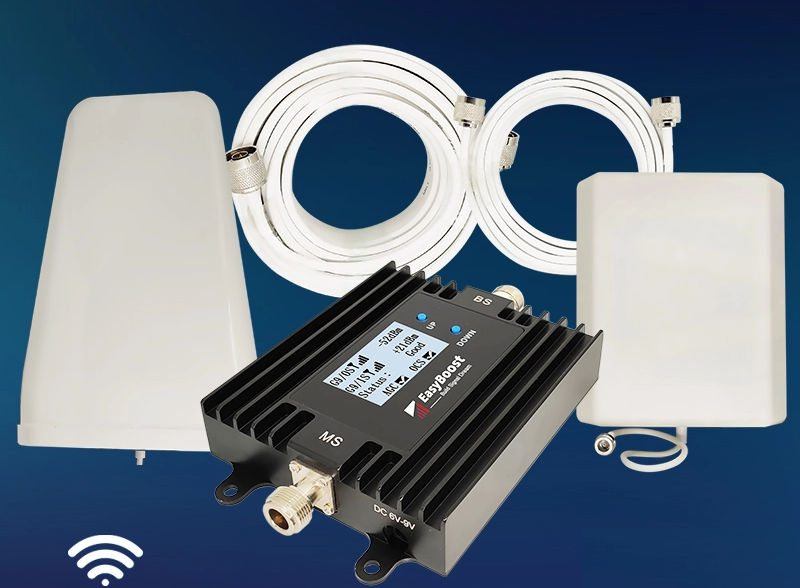
- Check the booster specification. Confirm supported bands, bandwidths, gain, output power, automatic gain control, and oscillation protection.
- Check the complete kit. Antennas, splitters, connectors, and cables must support the same frequency range.
- Plan antenna separation. The outdoor and indoor antennas must be isolated sufficiently to prevent feedback.
- Estimate cable loss. Long or unsuitable coaxial cables can remove much of the available gain.
- Verify certification. Purchase only equipment permitted for use in your country and on the relevant network.
Single-Band Boosters
A single-band booster may be appropriate when one band provides the required service consistently.
However, it is not automatically the best option in either an urban or rural area. The decision must be based on the bands actually used at the property.
Multi-Band Boosters
A multi-band system can support several coverage and capacity bands. This may be useful when phones use carrier aggregation or when multiple services operate on different bands.
Nevertheless, more bands do not automatically produce better performance. The device still needs a usable outdoor signal, suitable antennas, correct installation, and legal authorization.
Why 5G Signal Booster Selection Is Complicated
The presence of a 5G symbol on a phone does not always reveal the complete radio connection.
5G Non-Standalone Networks
In a Non-Standalone deployment, a phone may use LTE as an anchor while also connecting to a 5G carrier.
As a result, boosting only the displayed 5G frequency may not provide the expected service if the required LTE anchor band is missing.
5G Standalone Networks
A Standalone 5G network can operate without an LTE anchor. However, the required bands, voice support, and device behavior still depend on the operator’s deployment.
Frequency Division and Time Division Duplexing
Many lower mobile bands use separate frequency ranges for uplink and downlink. This is known as frequency-division duplexing.
By contrast, much of the 3.5 GHz 5G spectrum uses time-division duplexing, where uplink and downlink share the same frequency at different times.
A repeater must be specifically designed and authorized for the relevant duplex arrangement. Therefore, an ordinary LTE amplifier should not be assumed to support n77 or n78.
Misleading “5G Compatible” Labels
Some products described as 5G compatible support only particular low-band or refarmed frequencies. Others may simply pass certain frequencies through passive components.
Always check the exact supported NR bands and technical certification rather than relying on a general 5G logo.
Choosing Outdoor and Indoor Antennas
Directional Outdoor Antenna
A directional antenna concentrates reception toward a particular direction.
It can be useful when:
- the intended base station direction is known
- the signal is weak but measurable
- interference arrives from other directions
- several operators or cells are present
Correct aiming should be based on signal-quality measurements rather than visual direction alone.
Omnidirectional Outdoor Antenna
An omnidirectional antenna receives signals from multiple directions.
It can simplify installation when the outdoor signal is already strong or when users need service from different operators. However, it may also receive more interference.
Indoor Panel Antenna
A panel antenna directs indoor coverage toward a room or part of a floor. It can also help increase isolation from the outdoor antenna when positioned correctly.
Indoor Ceiling Antenna
A ceiling antenna can distribute service around an open area. Nevertheless, walls, floors, and metal structures may limit how far the signal travels.
Check the Frequency Range
Every antenna, cable, connector, and splitter in the system must support the required bands.
An antenna designed only for lower LTE frequencies may perform poorly at 3.5 GHz. Similarly, excessive cable loss becomes increasingly important at higher frequencies.
Installation, Cable Loss and Antenna Isolation
Correct installation is as important as choosing the correct frequency bands.
Separate the Antennas
If the indoor and outdoor antennas can strongly receive each other, the system may oscillate. This is similar to audio feedback between a microphone and speaker.
A compliant booster may reduce its gain or shut down when it detects oscillation. However, an unsuitable device could cause harmful interference.
Increase physical separation and use the building structure or directional antennas to improve isolation.
Keep Cables Practical
Every coaxial cable introduces loss. Furthermore, loss generally increases with frequency and cable length.
Use the cable type and connectors specified by the manufacturer. Avoid unnecessary adapters, tight bends, damaged connectors, and excessive cable runs.
Protect Outdoor Connections
Outdoor connectors should be weatherproofed using an appropriate method. In addition, the antenna mast and cable installation may require grounding or lightning protection according to local electrical and building requirements.
Follow the Manufacturer’s Instructions
Use only the approved antennas, cables, splitters, and power supplies specified for the booster.
Changing system components can alter gain, emissions, and regulatory compliance.
For additional installation guidance, see
How to Properly Install a Mobile Phone Signal Booster.
Legal Requirements for Mobile Signal Boosters
Mobile boosters transmit in licensed radio spectrum. Therefore, their installation and use are regulated and the rules differ between countries.
Do not import or operate an unverified repeater merely because its frequency range appears compatible.
United Kingdom
In the United Kingdom, only repeaters that satisfy the applicable licence-exemption requirements may be installed and used without an individual licence.
Ofcom explains that using a repeater outside a licence or applicable exemption is illegal. Before purchasing equipment, review
Ofcom guidance on mobile phone repeaters.
United States
In the United States, consumer signal boosters must meet FCC requirements. Users must operate certified equipment, obtain provider consent, and register the booster with the appropriate wireless provider.
The FCC also requires users to stop operating a device if instructed because it is causing harmful interference. Consult the
FCC signal booster information
and your mobile provider before installation.
Other Countries
Elsewhere, contact the national telecommunications regulator and mobile operator.
CE marking or another general product mark does not by itself prove that a particular repeater may be legally operated on every network or in every country.
Alternatives to a Mobile Signal Booster
A booster is not always the simplest or most effective solution.
Wi-Fi Calling
If the fixed internet connection is reliable, Wi-Fi Calling may provide indoor voice and messaging service without retransmitting licensed mobile spectrum.
Support depends on the phone, operator, subscription, and emergency-calling requirements.
Operator-Supplied Indoor Coverage Equipment
Some operators provide approved indoor coverage solutions, managed repeaters, or small-cell equipment.
Because availability varies, ask the operator which options are currently supported.
Outdoor Cellular Router
For mobile broadband, an outdoor or externally connected cellular router may perform better than an indoor phone because its modem and antennas can be positioned where reception is stronger.
However, confirm operator compatibility, supported bands, antenna specifications, and local installation rules.
Improve the Indoor Wi-Fi Network
If mobile internet already enters the property through a router, improving Wi-Fi coverage may be more useful than boosting the cellular signal throughout the building.
See our guide explaining
how to improve Wi-Fi coverage in a large home.
Common 4G and 5G Booster Buying Mistakes
Choosing by Frequency Name Alone
A number such as 700 MHz or 2100 MHz is not enough. Confirm the exact band, uplink and downlink ranges, duplex method, and operator deployment.
Assuming Every Area Uses the Same Bands
Operators can use different bands at different base stations. Therefore, a recommendation that works in one town may be unsuitable somewhere else.
Buying the “Most Powerful” Booster
Excessive gain does not compensate for poor signal quality or an incorrect band. In addition, too much gain can cause oscillation and interference.
Ignoring Upload Performance
A system must support communication in both directions. A phone may display improved bars while calls or uploads remain unreliable if the uplink path is poor.
Assuming 5G Support Means n78 Support
A booster may support only low-band 5G. Always check the exact NR bands and duplex technologies.
Ignoring Cable Loss
A long, low-quality coaxial cable can remove much of the signal gained by the outdoor antenna, particularly at higher frequencies.
Using an Uncertified Repeater
An illegal or poorly designed repeater can interfere with the mobile network and other users. Purchase only equipment permitted by the national regulator and accepted by the relevant operator where required.
Expecting a Booster to Create Service
A repeater needs a usable donor signal. If no suitable service exists outdoors, Wi-Fi Calling, an operator solution, or another connectivity method may be more appropriate.
Frequently Asked Questions
What is the best frequency for a 4G signal booster?
There is no universally best frequency. The booster must support the bands used by your operator at the installation location.
Lower bands often provide broader coverage, while higher bands may provide more capacity. Nevertheless, actual performance depends on signal quality, bandwidth, congestion, and installation.
What is the best frequency for a 5G booster?
The correct frequency is the one used by your operator for the required 5G service.
Depending on the network, this may be a low band such as n28, a refarmed band such as n1, or mid-band spectrum such as n78.
Can one booster support both 4G and 5G?
Yes, but only when the device specifically supports the required LTE and NR bands and is authorized for use in the country.
A generic “4G/5G” label is not sufficient evidence of compatibility.
Will a 4G booster improve 5G?
It may improve the LTE anchor used by some Non-Standalone 5G connections, but it will not necessarily amplify the 5G carrier.
The result depends on the operator’s network architecture and the bands supported by the booster.
Can a signal booster improve internet speed?
It can improve data performance when weak or unstable indoor radio conditions are the main limitation.
However, it cannot remove network congestion, increase the operator’s available spectrum, or exceed the capabilities of the phone and network.
Does a booster work when there is no outdoor signal?
Generally, no. A conventional repeater requires a usable outdoor donor signal.
If no service is available, consider Wi-Fi Calling, another operator, a satellite service, or an operator-approved alternative.
Is a mobile signal booster legal?
That depends on the country, equipment, and installation.
Check the national regulator’s rules and the mobile operator’s requirements before buying or operating a booster.
Should I choose a directional or omnidirectional antenna?
A directional antenna may help when the desired base station direction is known or interference must be reduced.
An omnidirectional antenna can be convenient when signals arrive from several directions. The better choice depends on measurements at the property.
Can I install a signal booster myself?
Self-installation may be allowed for certain compliant products in some countries.
Nevertheless, the equipment must meet local requirements and be installed according to its approved instructions. Complex multi-antenna systems may require professional design.
Final Thoughts
The correct 4G 5G signal booster is determined by the network bands available at the property rather than by a generic urban, rural, or coverage-area label.
First, identify the operator and measure the outdoor signal. Next, confirm the active LTE and 5G bands, voice requirements, signal quality, antenna positions, and cable route. Finally, verify that the complete system is legal and certified for use in your country.
Low-frequency bands often provide useful coverage, while higher-frequency bands may add capacity. However, a multi-band booster is beneficial only when it supports the services actually used by the network.
When the outdoor signal is absent or the legal requirements cannot be satisfied, Wi-Fi Calling, operator-managed equipment, or another connectivity solution may be safer and more effective.