What to Look for When Choosing a Portable Air Conditioner
The most powerful model is not automatically the best choice. A portable AC should match the room’s heat load and have a properly installed exhaust system that allows hot air to leave the space efficiently.
This guide explains how to compare portable air conditioners and which specifications deserve the most attention before you buy.
1. Start With Room Size and Heat Load
Room size is the first specification to consider, but floor area alone does not determine how much cooling a space requires.
A portable air conditioner may need additional cooling capacity when the room has:
- Large south- or west-facing windows
- Strong direct sunlight
- Poor insulation
- High ceilings
- Several regular occupants
- Computers, televisions, or other heat-producing equipment
- An open connection to adjoining rooms
Use the manufacturer’s recommended room size as a starting point rather than a guarantee. Room conditions and installation quality can significantly affect real-world performance.
A unit that is too small may operate continuously without reaching the desired temperature. An unnecessarily oversized model may cost more, occupy additional space, and use more power than the room requires.
Rooms containing a home theater PC or a home theater projector may require additional cooling because this equipment produces heat during operation.
2. Compare Cooling Capacity in BTU or kW
Cooling capacity describes how much heat an air conditioner can remove from a room. It is normally expressed in British thermal units per hour, written as BTU/h, or in kilowatts.
Portable air conditioners are generally available in several capacity ranges:
- Lower-capacity models: intended for small bedrooms and compact offices
- Mid-range models: suitable for many medium bedrooms, living rooms, and offices
- Higher-capacity models: designed for larger rooms or spaces with greater heat loads
Do not compare products only by the largest BTU figure printed on the packaging. Rating methods can differ between markets and manufacturers, so look for standardized cooling-performance figures when they are available.
As a useful conversion:
- 1 kW of cooling capacity is approximately 3,412 BTU/h.
This conversion can help when comparing models advertised using different units.
3. Single-Hose vs Dual-Hose Portable Air Conditioners
The exhaust design can have a major influence on portable air conditioner performance.
Single-hose systems
A single-hose unit draws air from the room, passes it across the condenser, and sends the resulting hot air outdoors through one exhaust hose.
Because air is removed from the room, replacement air may enter through gaps around doors, windows, and other openings. When that replacement air is warm, the air conditioner has to work harder to maintain the target temperature.
Dual-hose systems
A dual-hose model normally uses one hose to bring in outside air for the condenser and another to discharge hot air outdoors.
This arrangement can reduce negative pressure inside the room and may improve cooling performance under demanding conditions.
A dual-hose model is not automatically the best choice in every situation. Overall performance still depends on the compressor, heat exchangers, controls, installation, and efficiency of the complete unit.
4. Check Energy Efficiency and Power Consumption
Portable air conditioners can consume a substantial amount of electricity during hot weather. Efficiency becomes particularly important when the unit operates for several hours each day.
When comparing models, check:
- Rated electrical power consumption
- Cooling capacity
- EER, CEER, or the efficiency metric used in your region
- Official energy-label information
- Estimated annual or seasonal energy consumption, when provided
Marketing terms such as “Eco Mode” provide limited information by themselves. Published efficiency figures and power consumption are more useful for comparing different units.
Variable-speed compressors
Some portable air conditioners use variable-speed or inverter compressor technology. Instead of repeatedly switching between full output and off, these systems can adjust their cooling output as conditions change.
Depending on the model and operating conditions, variable-speed control may improve temperature consistency, energy efficiency, and noise characteristics.
5. Consider Airflow and Fan Speeds
Cooling capacity indicates how much heat a unit can remove, while airflow affects how effectively the cooled air is distributed around the room.
Useful airflow features include:
- Multiple fan speeds
- Automatic fan control
- Adjustable louvers
- Oscillating air direction
Higher airflow can help distribute cool air when a room is initially hot. A lower fan setting may feel more comfortable once the room approaches the selected temperature.
The position of the unit also matters. Avoid placing it where furniture, curtains, or walls obstruct the air inlet or cooled-air outlet.
6. Compare the Noise Level
Portable air conditioners are generally noisier than split air-conditioning systems because the compressor and fans are located inside the room.
Noise is usually specified in decibels, but published figures require careful comparison. One manufacturer may advertise the minimum sound level, while another lists the maximum or a measurement for a particular operating mode.
For a bedroom or home office, look for:
- Minimum and maximum noise specifications
- A sleep or night mode
- Variable-speed operation, when available
- Reviews that describe compressor, fan, and airflow noise during normal use
Even a small difference in measured sound level can be noticeable in a quiet room, especially at night.
7. Look for Useful Operating Modes
Most portable AC units include several operating modes. The following are the most useful for everyday use.
Cooling mode
Cooling mode operates the compressor and fan to reduce the room temperature.
Fan mode
Fan mode circulates indoor air without operating the cooling system. It can be useful when the room is already comfortable but needs additional airflow.
Dehumidification mode
This mode removes moisture from the air and may make humid conditions feel more comfortable. Drainage requirements can vary between models.
Automatic mode
Automatic mode allows the unit to adjust its operation according to the measured room temperature and its programmed control logic.
Sleep mode
Sleep mode may reduce fan speed, dim the display, or gradually adjust the selected temperature to make nighttime operation more comfortable.
Timer and scheduling
A timer can switch the unit on or off automatically. Programmable schedules may help reduce unnecessary operation when nobody is using the room.
8. Understand Condensate and Drainage
Air conditioners remove moisture from indoor air as part of the cooling process. The resulting water must be collected, drained, or exhausted.
Portable units may use:
- An internal collection tank: the tank must be emptied when it becomes full.
- Continuous drainage: water flows through an attached drain hose.
- A self-evaporative system: some condensate is reused and discharged with the exhaust air.
A self-evaporative model may still require manual or continuous drainage in very humid conditions.
If you live in a humid climate or plan to use the dehumidification mode frequently, check the drainage arrangement and the position of the drain outlet before buying.
9. Check the Window Kit and Exhaust Installation
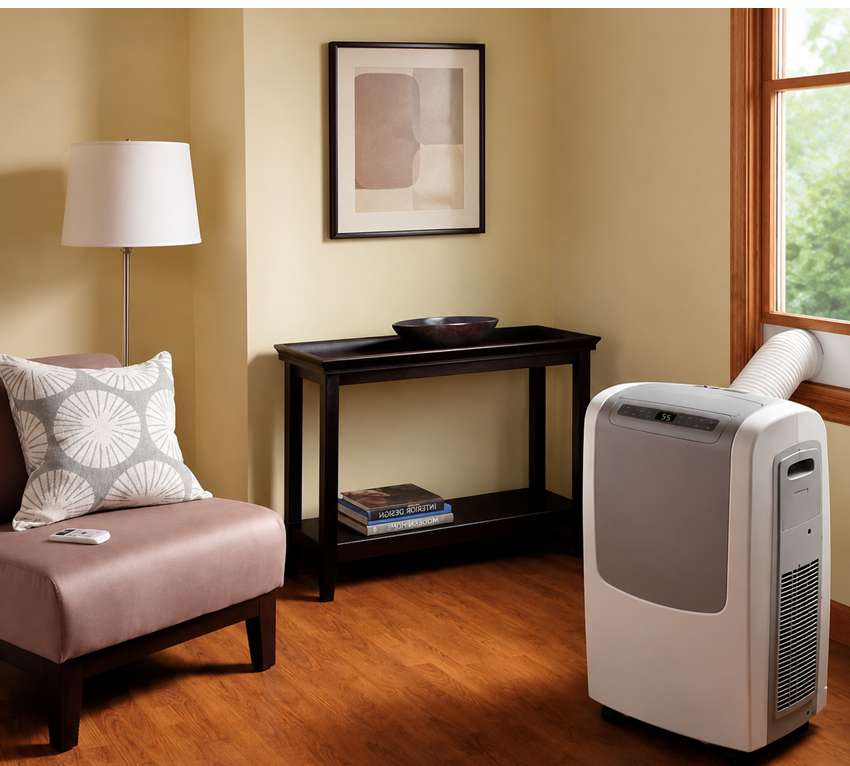
A portable air conditioner must transfer heat outdoors. The exhaust hose and window kit are therefore essential parts of the cooling system rather than optional accessories.
Before buying, confirm that the included kit is compatible with your window type. Standard kits are often designed for:
- Vertically opening sash windows
- Horizontally sliding windows
- Some sliding doors
Casement, hinged, and tilt-and-turn windows may require a separate sealing solution.
Follow the manufacturer’s instructions for the permitted hose length and installation position. Avoid:
- Unnecessary hose extensions
- Sharp bends in the exhaust hose
- Crushing or restricting the hose
- Positioning the hose against heat-sensitive materials
- Allowing hot exhaust air to leak back into the room
A poorly sealed window opening allows warm outdoor air to enter and reduces cooling performance. The exhaust route should be as short and direct as the manufacturer permits.
10. Decide Which Extra Features Are Worth Having
Convenience features can improve everyday use, but they should come after cooling capacity, efficiency, noise, drainage, and installation requirements.
Potentially useful features include:
- Remote control
- Wi-Fi or app control
- Programmable schedules
- Washable air filters
- Filter-cleaning reminders
- Child lock
- Automatic restart after a power interruption
- Casters and carrying handles
- Automatic evaporator protection
If the original controller is lost or damaged, read our guide to universal air conditioner remotes to learn about compatibility, setup, and replacement remote codes.
Anti-freeze protection can help prevent excessive ice formation on the evaporator under unsuitable operating conditions. It is a useful protective function, but it should not be the main reason for choosing a particular model.
11. Common Portable Air Conditioner Buying Mistakes
- Choosing by floor area alone: sunlight, insulation, ceiling height, occupancy, and equipment also affect the heat load.
- Ignoring the exhaust system: a poorly routed or leaking hose can noticeably reduce cooling performance.
- Automatically buying the highest-BTU model: more capacity is not always necessary or beneficial in a small room.
- Overlooking noise: a powerful unit may be uncomfortable in a bedroom or quiet office.
- Forgetting about drainage: humid conditions can produce more condensate than expected.
- Not checking the window kit: make sure the exhaust system can be installed before ordering the unit.
- Expecting split-system performance: portable units offer easier installation and mobility, but they are usually less quiet and efficient than comparable split systems.
Frequently Asked Questions
What size portable air conditioner do I need?
The correct capacity depends on the room’s floor area and total heat load. Start with the manufacturer’s room-size recommendation, then consider sunlight, insulation, ceiling height, occupancy, adjoining spaces, and heat-producing electronics.
Are dual-hose portable air conditioners better?
A dual-hose system can reduce the amount of replacement air drawn into the room and may perform more efficiently in some conditions. However, real-world results depend on the overall design and installation of the unit.
Can a portable air conditioner work without a window?
A portable air conditioner needs a suitable way to exhaust hot air outdoors. A window is the most common option, but a properly designed exterior vent may also be possible if it complies with the manufacturer’s installation requirements.
Can I extend the exhaust hose?
Avoid extending the hose unless the manufacturer specifically permits it. A longer exhaust route can increase airflow resistance, retain more heat inside the room, and reduce performance.
How much electricity does a portable air conditioner use?
Electricity use depends on the unit’s rated input power, operating time, efficiency, selected temperature, room conditions, and local climate. Use the rated wattage and your electricity tariff to estimate operating cost.
Do portable air conditioners reduce humidity?
Yes. Cooling naturally removes some moisture from indoor air, and many models also include a dedicated dehumidification mode. The amount removed and the required drainage method vary between units.
Can I use a portable air conditioner in a bedroom?
A portable AC can cool a bedroom when permanent air conditioning is unavailable, but noise deserves special attention. Compare low-speed sound levels and look for a suitable sleep mode if the unit will operate overnight.
What to Look for When Choosing a Portable Air Conditioner
The best portable air conditioner is one that matches the room, operates at an acceptable noise level, and can be installed correctly.
Prioritize:
- Appropriate cooling capacity
- Room size and heat load
- Single- or dual-hose design
- Energy efficiency
- Noise level
- Drainage requirements
- Window-kit compatibility
- Filter access and maintenance
After comparing these essentials, consider convenience features such as Wi-Fi control, timers, schedules, and sleep modes.
A correctly sized portable air conditioner with a short, properly sealed exhaust path will generally perform better than a more powerful model installed poorly.